


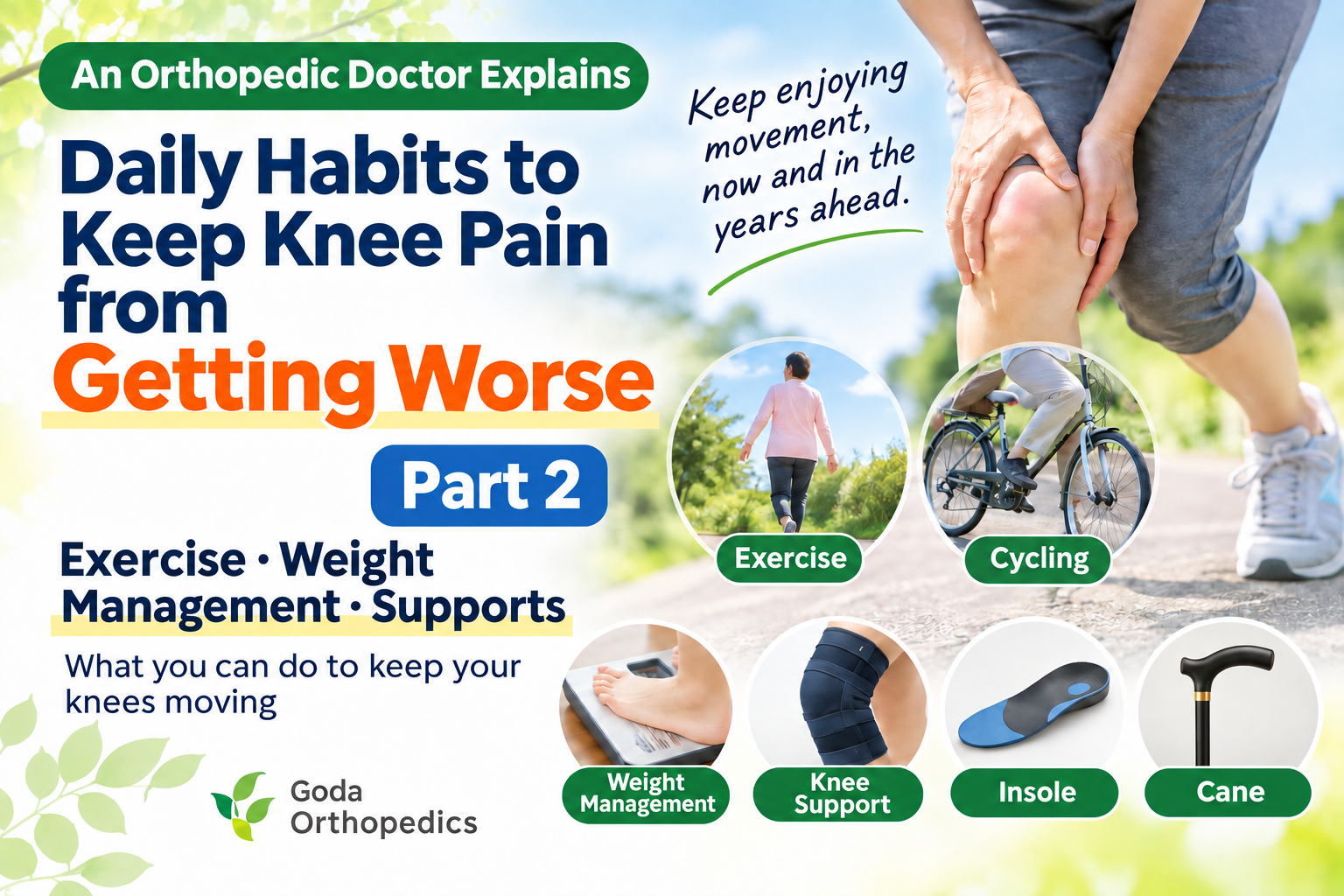
K-008 Daily Habits to Keep Knee Pain from Getting Worse | Walking, Stairs, Exercise and Weight Management
Part 2: Exercise, Weight Management and Supports | What You Can Do to Keep Your Knees Working Well
Medical review
Keeping your knees working well for as long as possible involves more than avoiding pain. It is also important to maintain your physical function through activity you can manage, while paying attention to your weight and everyday surroundings.
9. Knee pain does not mean you have to stop exercising
At Goda Orthopedics, our usual advice is not, “Your knees are bad, so you should stop exercising.”
The important question is which types of exercise you can continue with your knees as they are now.
Exercise does not mean ignoring pain. However, it is also important to avoid becoming completely inactive out of fear of pain.
10. You can continue walking
Walking is an accessible form of exercise for many people with knee osteoarthritis. Adjust the distance, pace, hills and number of rest breaks so that the pain does not become worse.
You do not need to focus only on a target such as “I must walk a certain number of thousand steps every day.” What matters is continuing in a way that takes account of how your knee feels that day.
11. Cycling can be manageable even with knee pain
A bicycle or stationary bike does not require the knees to support your full body weight continuously. Some patients therefore find cycling easier to manage than walking.
However, a saddle that is too low makes the knee bend deeply. If your knee hurts, it is important to adjust the saddle height so that you do not bend the knee more deeply than necessary.
12. Strengthening the quadriceps is very important
The quadriceps, the muscles at the front of the thigh, are among the main muscles that support the knee. Strength training, particularly for the quadriceps, is important in knee osteoarthritis.
At Goda Orthopedics, we also place particular emphasis on quadriceps exercises during rehabilitation for knee pain. If severe pain makes it difficult to move the knee through a large range, you may be able to begin with isometric exercises. These involve tightening the muscles without bending and straightening the knee through a large range of movement.
13. Deeper squats are not always better
Squats are an effective way to strengthen the quadriceps, but bending more deeply also increases the load on the knee. In particular, we do not recommend very deep squats, with the buttocks close to the floor, for patients with knee pain.
At Goda Orthopedics, depending on the symptoms, we sometimes use a knee bend of up to approximately 90 degrees as one guide.
This does not mean that a 90-degree squat places no load on the knee. If your knee hurts, it is important to adjust the depth, number of repetitions, speed and resistance.
14. Walking in water reduces the weight your knees have to bear
Walking in a pool allows you to exercise with less body weight passing through your joints because the water supports you through buoyancy.
It can be an option for patients who find walking on land painful, or who find it difficult to begin exercising because of their body weight.
15. Sports do not all need to be prohibited
Sports and activities that people have enjoyed for many years, such as golf, tennis, skiing and walking, can be an important source of pleasure in everyday life.
There is therefore no need to give everyone the same advice to stop all of these activities because their knees are affected.
However, different sports place different demands on the knees, including changes of direction, jumping, sudden stops, deep bending and prolonged weight-bearing.
It is important to consider both the activity and the condition of the knee, and think about how the person might be able to continue.
16. Weight loss is one part of knee treatment
Weight gain increases the load on the knees during daily activities such as walking and using stairs. Weight management is therefore an important part of treatment for people with knee osteoarthritis who are overweight or have obesity.
Weight loss has been reported to improve knee pain and physical function. Rather than simply saying, “Please lose weight,” it is important to work together to find an approach that the person can realistically continue.
17. “Exercise to lose weight” is not enough for some patients
There is a major difficulty here. Some patients want to lose weight because their knees hurt, but the pain prevents them from exercising enough.
In this situation, simply telling someone to exercise and lose weight may not provide an adequate treatment plan.
At Goda Orthopedics, when obesity or weight gain contributes to knee pain, we consider weight management options that include diet and exercise, as well as medical treatment for weight loss under a doctor’s supervision when appropriate.
A recent clinical trial in people with obesity and knee osteoarthritis has also reported improvements in knee pain and physical function, as well as weight, with medical weight-loss treatment.
Medication for obesity is not necessary for everyone. Treatment requires assessment of eligibility, side effects, nutritional status, muscle mass and other relevant factors.
18. Using a cane is not a sign of weakness
Some older patients are reluctant to use a cane because they feel that it suddenly makes them seem older.
However, a cane can reduce the load on the knee, help prevent falls and make walking more stable. Using one when you need it is not a step backward.
19. Use a knee support as an aid
When knee pain is severe, some patients find that a knee support gives them a greater sense of stability or makes walking easier.
At Goda Orthopedics, we emphasize combining a support with strength training rather than continuing to rely on the support alone.
It is too simplistic to assume that wearing a support will necessarily cause muscle wasting. The important thing is to use it when needed while also maintaining your own muscle strength.
20. The same insole is not right for everyone
Insoles or similar devices may be considered when there is marked bow-legged alignment and the weight-bearing axis is shifted toward the inner side of the knee.
However, it is not as simple as raising the outer edge of an insole for everyone with bow legs. The decision needs to be individualized after assessing alignment, the location of pain, changes in the shape of the joint, walking pattern and the condition of the feet.
21. Do not leave it at “It is just your age”
We often hear this from people with knee osteoarthritis:
“At my previous clinic, I was told that it was just my age and there was nothing to be done.”
At Goda Orthopedics, we do not want a consultation to end with those words.
If age alone caused changes in knee shape, everyone of the same age would have the same changes. That is not what we see.
Many factors contribute to these changes, including:
- Alignment of the leg and knee.
- Years of work and daily activities.
- Sports participation.
- Previous injuries.
- The condition of the meniscus and cartilage.
- Muscle strength.
- Body weight.
22. Think of your knees as having worked hard for you
We sometimes explain it to patients this way:
“Your knees have worked hard for you over the years. The load may have gradually accumulated and led to some changes.”
Changes in the shape of your knee do not mean that you have lived your life the wrong way.
You have worked, supported your family, played sports and walked. Your knees have been part of that life.
Now it is time to care for those knees and consider how to reduce pain so that you can keep using them. We believe that helping you do this is part of the role of orthopedic care.
23. Understanding why the knee hurts is important
Saying only “It is your age” does not lead to a treatment plan.
Once we identify contributing factors, such as damaged cartilage, an uneven weight-bearing axis, a damaged meniscus, reduced muscle strength or weight gain, we can see what to do next.
If the muscles are weak, we use rehabilitation. If body weight is adding to the load, we address weight management. If inflammation is marked, we treat it. If nonsurgical treatment does not provide enough improvement, we consider further options, including regenerative medicine or surgery.
Understanding the cause is the starting point for treatment.
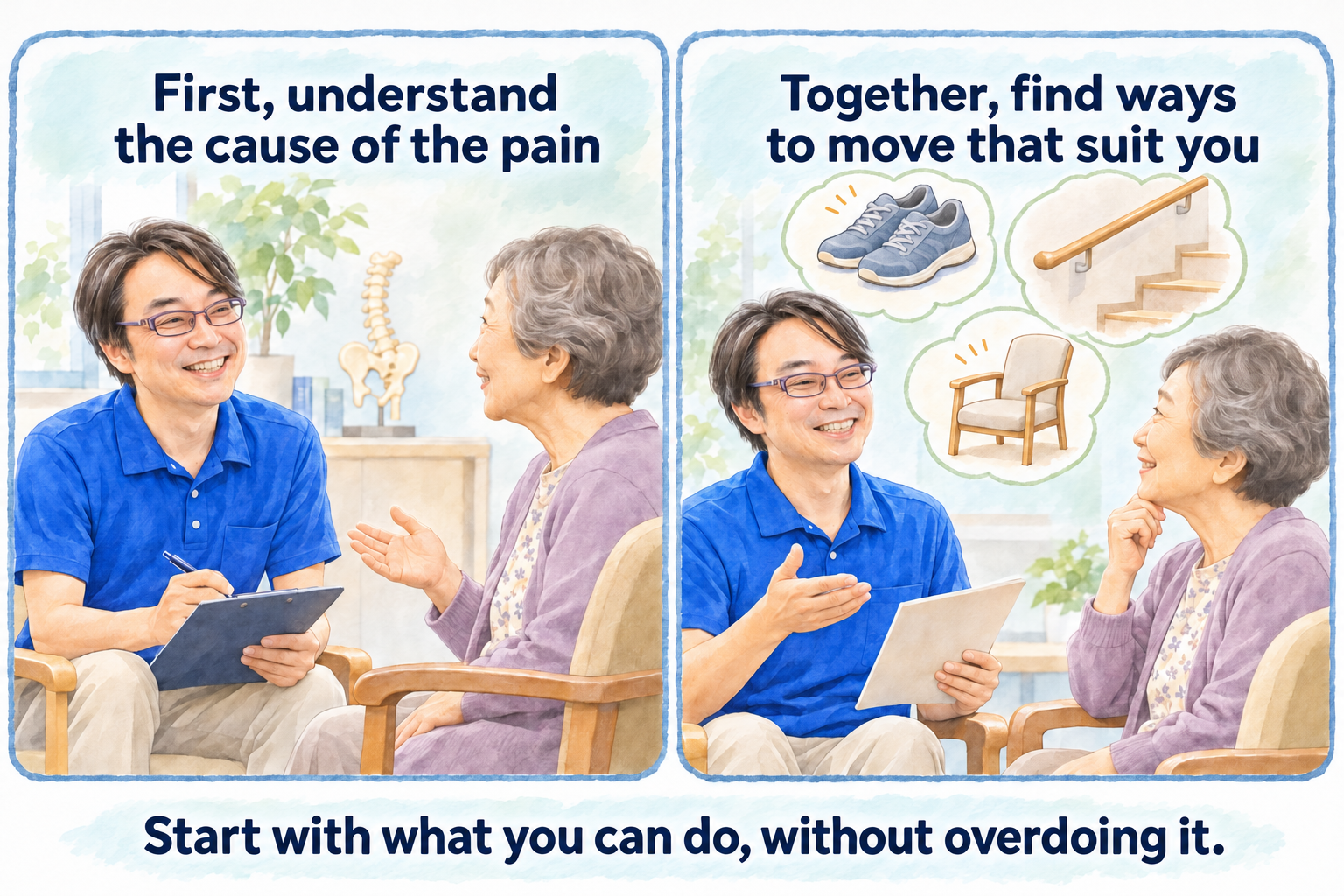
Summary: Keeping your knees working well for longer
The best way to keep knee pain from getting worse is neither to stop doing everything because your knees hurt nor to push through the pain.
It is important to understand why your own knees hurt and continue with steps such as these:
- Reduce activities that involve deep knee bending.
- Learn a way of walking that suits you.
- Walk within a manageable range.
- Strengthen your quadriceps.
- Manage your weight.
- Use a cane or supportive device when needed.
- Have the knee reassessed if symptoms change.
There is no need to leave it at “It is just my age, so nothing can be done.”
Your knees have worked hard for you. Let us work together to care for them and find ways to help you stay on your feet for as long as possible.
Frequently asked questions
Q1. Is it better not to walk if I have knee osteoarthritis?
No. Walking without making the pain worse is important for maintaining muscle strength and physical function. Adjust the distance or amount of exercise if you develop severe pain or swelling.
Q2. Do I have to avoid sitting in seiza?
Seiza, the Japanese kneeling position in which you sit back on your heels, is not absolutely prohibited. However, if it causes pain, it is better not to force yourself to stay in that position for a long time.
Q3. Are squats bad for the knees?
Squats can be useful for strengthening the quadriceps when performed within a suitable range. If you have knee pain, avoid squatting too deeply and adjust the depth and number of repetitions according to your symptoms.
Q4. Can I ride a bicycle if my knees hurt?
Many patients can. A saddle that is too low makes the knee bend deeply, so adjust it to a suitable height.
Q5. Should I cool or warm my knee?
Cooling may provide relief when there is marked acute swelling or warmth. For chronic stiffness or pain, some people find warmth, such as a bath, helpful.
Q6. Can losing weight improve knee pain?
For people with knee osteoarthritis who are overweight or have obesity, weight loss may improve pain and physical function.
Q7. Can I use a knee support every day?
A support can be useful when needed. However, it is important to combine it with measures such as strength training rather than relying on the support alone.
Q8. Does being older mean my knee pain cannot improve?
Age alone does not mean that treatment is no longer possible. We investigate the cause of the pain and combine options such as exercise, weight management, medication, injections, rehabilitation and, when necessary, surgery.
Related reading
- K-001 Part 1: Where Does Your Knee Hurt? Pain at the Front, Inner Side or Outer Side of the Knee
- K-002 Part 1: Knee Pain with Daily Movements: Walking, Stairs and Standing Up
- K-003 Part 1: Knee Swelling, Fluid and Warmth
- K-004 Part 1: Knee Pain That Needs Prompt Assessment
- K-004 Part 2: Knee Pain You May Be Able to Monitor and When to Seek Care
- K-005 Part 1: How We Assess and Diagnose Knee Pain
- K-006 Part 1: Knee Pain and X-rays: Why Standing Images Matter
- K-007 Part 1: Knee Pain Treatment: Medication and Injections
About the medical review
This article is based primarily on Dr. Goda’s clinical experience and practical approach to treating knee conditions in general orthopedic practice. It does not present a specialist opinion from a knee specialist.
The medical review cross-checks the following points against standard clinical practice guidelines and clinical studies: exercise therapy and appropriate weight management are central to treating knee osteoarthritis; aquatic exercise and cycling may be suitable options depending on symptoms; canes and supportive devices can help some patients; and changes to walking patterns and the use of insoles should be considered individually rather than recommended to everyone.
Key references
The original Japanese article identifies the following guidelines and the STEP 9 clinical trial among the main sources used for medical verification.
- National Institute for Health and Care Excellence (NICE). Osteoarthritis in over 16s: diagnosis and management (NG226). Published October 19, 2022.
- American Academy of Orthopaedic Surgeons (AAOS). Management of Osteoarthritis of the Knee (Non-Arthroplasty), Third Edition. Evidence-Based Clinical Practice Guideline. Published August 31, 2021.
- Bliddal H, et al.; STEP 9 Study Group. Once-Weekly Semaglutide in Persons with Obesity and Knee Osteoarthritis. New England Journal of Medicine. 2024;391(17):1573–1583. doi:10.1056/NEJMoa2403664.
Reviewer profiles
Taketoshi Goda
Chairman, GOZEN Medical Corporation
Orthopedic specialist; Doctor of Medical Science
Takuro Sasaki
Director, Kita 7-jo Goda Orthopedics
Orthopedic specialist; Doctor of Medical Science; occupational physician; Japan Sport Association-certified sports doctor
Naoki Seito
Director, Iwamizawa Goda Orthopedics
Orthopedic specialist; Doctor of Medical Science; Japanese Society for Replacement Arthroplasty-certified physician; Japan Sport Association-certified sports doctor
Article information
Article number: K-008
Article title: Daily Habits to Keep Knee Pain from Getting Worse | Walking, Stairs, Exercise and Weight Management
Article section: Part 2 / Exercise, weight management, supportive devices and preventing recurrence
Series: Goda Orthopedics’ Guide to Knee Pain
Medical review: Taketoshi Goda / Takuro Sasaki / Naoki Seito
Original Japanese publication date:
Original Japanese update date:
English publication date:
Original article: K-008 Part 2 (Japanese)
Read Part 1
K-008 Part 1: Changing Everyday Movements | Walking, Stairs, Standing Up and Seiza


