


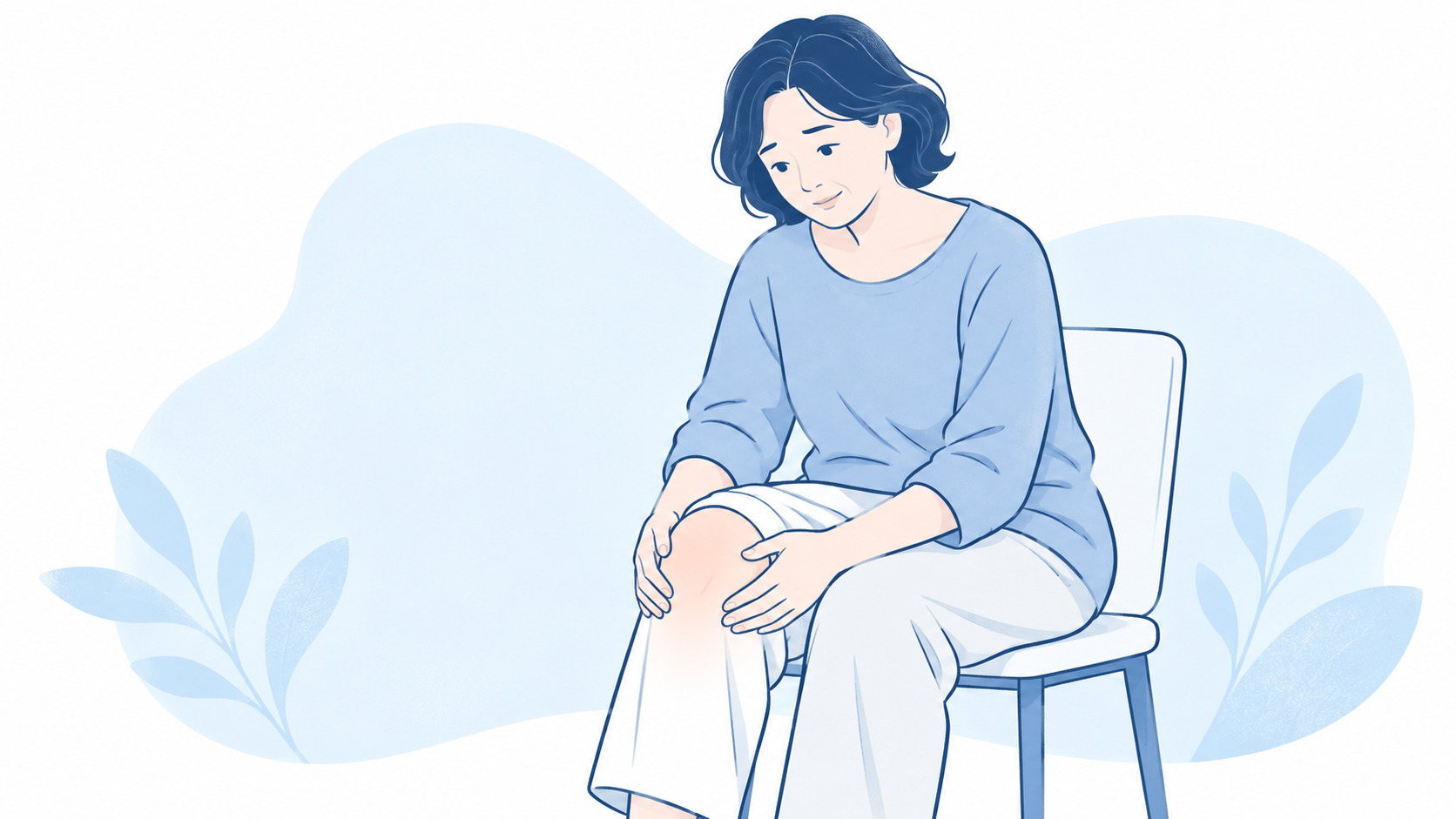
K-003 Symptoms That Accompany Knee Pain
Part 1: Knee Swelling, Fluid and Warmth | What Does “Fluid in the Knee” Mean?
Medical review
Some patients with knee pain also describe symptoms such as “My knee is swollen,” “I was told there is fluid in my knee,” “My knee feels hot,” or “It is becoming red.”
Knee swelling does not always mean that fluid has simply built up. There may be extra fluid inside the joint, inflammation and swelling of the joint lining itself, or blood that has collected after an injury.
When a knee is red and hot, it is particularly important not to overlook an infection in the joint, as well as considering arthritis caused by crystals, such as pseudogout.
In Part 1 of K-003, we explain why the knee can swell and what it means when fluid builds up in the joint.
1. What do we look for first when the whole knee is swollen?
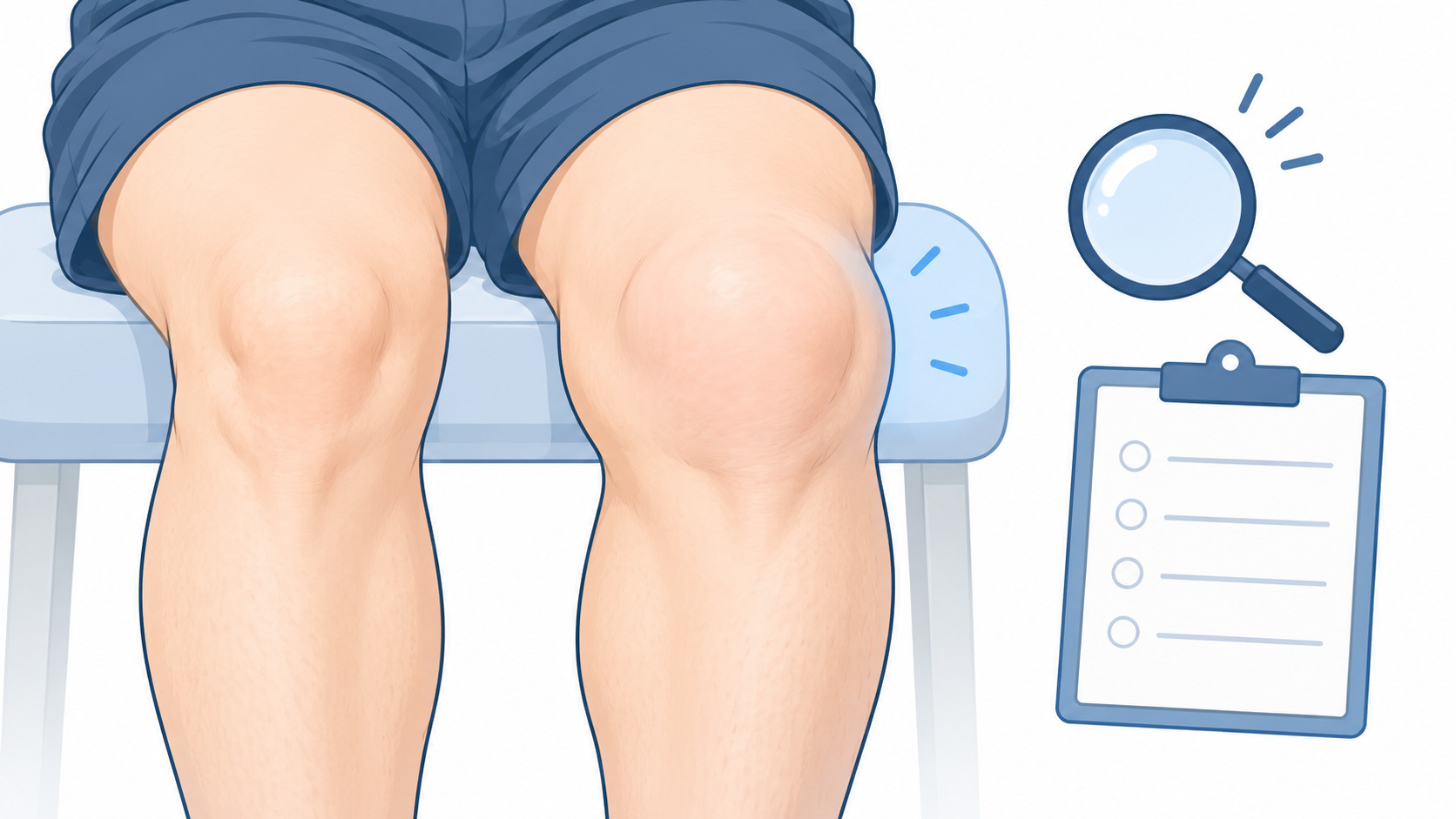
When a patient has a swollen knee, we first look at the knee as a whole.
Is only one knee affected, or both? Is there redness, warmth or bruising? Did the swelling appear suddenly, or did it develop gradually? We check these differences.
When the whole knee is swollen, we consider whether some form of inflammation may be present.
However, swelling alone does not tell us the cause. Many conditions can make the knee swell, including knee osteoarthritis, a meniscus injury, rheumatoid arthritis, crystal-induced arthritis, infection and injury. The menisci are the pads of cartilage that help cushion the knee.
2. Is the joint lining swollen, or has fluid built up?
The inside of the knee joint is lined with tissue called the synovium. When this tissue becomes inflamed, it can thicken and swell.
Inflammation can also increase the amount of joint fluid. When excess fluid collects inside the joint, this is called a joint effusion.
During an examination, we feel the knee to check whether the swelling feels thickened throughout, whether there is a wave-like movement suggesting fluid, and whether fluid has collected around the kneecap.
Inflammation of the joint lining, called synovitis, and a joint effusion can also occur at the same time.
3. Why does fluid build up in the knee?
Patients often ask, “Why does fluid build up in my knee?”
Joint fluid, also called synovial fluid, is present even in a normal knee. It helps the joint move smoothly.
However, inflammation or irritation inside the joint can cause more fluid than usual to be produced. Possible causes include knee osteoarthritis, a meniscus injury, trauma, synovitis, crystal-induced arthritis, rheumatoid arthritis and an infection in the joint.
“Fluid in the knee” is not the name of a disease. It is a result of something happening inside the knee. What matters is understanding why the fluid has built up.
4. Is one knee swollen, or are both knees swollen?
If only one knee is swollen, we consider whether there is a local problem in that knee, such as osteoarthritis, a meniscus injury, trauma, crystal-induced arthritis or infection.
If both knees are swollen, or if other joints are also swollen or painful, we also consider inflammatory diseases that can affect the body more broadly.
Conditions such as rheumatoid arthritis can cause symptoms in several joints. There are also conditions in which arthritis develops after an infection.
For this reason, it is important not only to examine the knee but also to ask questions such as “Do any other joints hurt?” and “Have you recently had a fever or symptoms of an infection?”
5. A red, hot knee needs careful attention
If a knee is not only swollen but also red, clearly hot to the touch and very painful, the inflammation may be severe.
Possible causes include crystal-induced arthritis such as pseudogout, inflammatory arthritis such as rheumatoid arthritis, and an infection in the joint.
Infectious arthritis, also called septic arthritis, is especially important to consider. Bacteria or other germs enter the joint and cause severe inflammation. If left untreated, this can damage the cartilage in the joint and, in severe cases, lead to sepsis, a life-threatening reaction to infection.
If an infection is suspected, it is important to perform joint aspiration promptly and test the fluid. Joint aspiration means using a needle to withdraw fluid from the joint.
6. Pseudogout can also cause sudden redness and swelling
When an older adult says, “My knee was fine yesterday, but suddenly it became swollen and painful,” we also consider calcium pyrophosphate deposition (CPPD) disease, which can cause an attack known as pseudogout.
Pseudogout can cause sudden swelling, severe pain, warmth, redness and fever.
This means that it can sometimes be difficult to distinguish pseudogout from an infection in the joint by appearance alone.
Finding calcium pyrophosphate (CPP) crystals in the joint fluid is an important clue. However, even when crystals are found, an infection occurring at the same time cannot be completely ruled out. Joint fluid tests are used as needed to distinguish infection from crystal-induced arthritis.
7. What can the appearance of joint fluid tell us?
When joint aspiration is performed, the doctor also checks how the fluid looks. Fluid that is close to normal is generally clear to pale yellow.
If the fluid is cloudy, whitish, mixed with blood or looks like pus, we consider inflammation, bleeding or other possible causes.
However, the color of joint fluid alone cannot establish a diagnosis. Cloudy fluid can occur in crystal-induced arthritis, infectious arthritis and inflammatory arthritis.
If an infection is suspected, tests include a cell count and differential (the number and types of cells present), Gram staining to look for bacteria, bacterial culture and examination for crystals.
8. What does blood in the joint fluid mean?
After a knee injury, blood can collect inside the joint. This is called hemarthrosis.
Possible causes include an anterior cruciate ligament (ACL) injury, kneecap dislocation, a fracture involving the joint, an injury to cartilage and the underlying bone, and some meniscus injuries.
However, a small blood vessel can also be struck by the needle during joint aspiration, allowing blood to mix with the fluid being collected.
Therefore, finding blood in the sample does not necessarily mean that bleeding had occurred inside the joint. We assess it together with the history of injury, how soon the swelling developed and findings on imaging.
9. Does draining fluid make the knee keep filling up again?
A very common question from patients is, “Once you drain fluid from the knee, does that make it keep coming back?”
Draining the fluid does not itself make the knee more likely to develop another buildup of fluid.
The issue is that the underlying cause may still be present. If inflammation from knee osteoarthritis, a meniscus injury, synovitis or crystal-induced arthritis continues, fluid may build up again even after it has been removed.
In other words, the fluid has not returned because it was drained. It has returned because the condition causing the extra fluid has not yet resolved.
10. If fluid keeps coming back, look for the cause
When a joint effusion keeps recurring, it is important to find out why the amount of fluid is increasing, rather than simply draining it each time.
Possible causes include knee osteoarthritis, a problem with the meniscus and chronic synovitis.
If a patient has marked swelling from fluid in the tissues, called edema, throughout the leg rather than just at the knee, we also need to assess their general health and the cause of the edema, not only the knee joint.
For recurring joint effusions, we add tests such as X-rays, MRI or blood tests according to the symptoms and examination findings.
Part 1 summary: “Fluid in the knee” is not a diagnosis
There is more than one possible cause of knee swelling or a buildup of fluid.
What matters is considering the findings together: whether the knee is swollen, warm or red; whether one or both knees are affected; whether symptoms began suddenly; and what the joint fluid is like.
Rather than stopping at “There is fluid, so we will drain it,” it is important to diagnose why the fluid has built up.
Continued in Part 2
K-003 Part 2: Catching, Locking, Giving Way and Sudden Swelling | Knee Symptoms to Pay Attention To
Part 2 explains catching, locking, a limited range of movement, giving way (when the knee unexpectedly buckles), knee noises, rapid swelling after an injury, symptoms that need prompt medical assessment, and how we choose among joint fluid tests, blood tests, X-rays and MRI.
About the medical review
This article is based primarily on Dr. Goda’s clinical experience and examination procedures in general orthopedic practice. It has been cross-checked against standard medical knowledge in orthopedics and rheumatology and edited for patients. It reflects points such as not diagnosing infection or CPPD from the appearance of joint fluid alone, and recognizing that finding crystals does not completely rule out an infection.
Key reference
Ravn C, et al. Guideline for management of septic arthritis in native joints (SANJO). Journal of Bone and Joint Infection. 2023;8:29–37. doi:10.5194/jbji-8-29-2023.
Reviewer profiles
Taketoshi Goda
Chairman, GOZEN Medical Corporation
Orthopedic specialist; Doctor of Medical Science
Takuro Sasaki
Director, Kita 7-jo Goda Orthopedics
Orthopedic specialist; Doctor of Medical Science; occupational physician; Japan Sport Association-certified sports doctor
Naoki Seito
Director, Iwamizawa Goda Orthopedics
Orthopedic specialist; Doctor of Medical Science; Japanese Society for Replacement Arthroplasty-certified physician; Japan Sport Association-certified sports doctor
Article information
Article number: K-003
Article title: Symptoms That Accompany Knee Pain | Swelling, Fluid, Warmth, Catching and Giving Way
Article section: Part 1 / Knee swelling, fluid buildup, warmth and joint fluid
Series: Goda Orthopedics’ Guide to Knee Pain
Medical review: Taketoshi Goda / Takuro Sasaki / Naoki Seito
Original Japanese publication date:
English publication date:
Original article: K-003 Part 1 (Japanese)


