


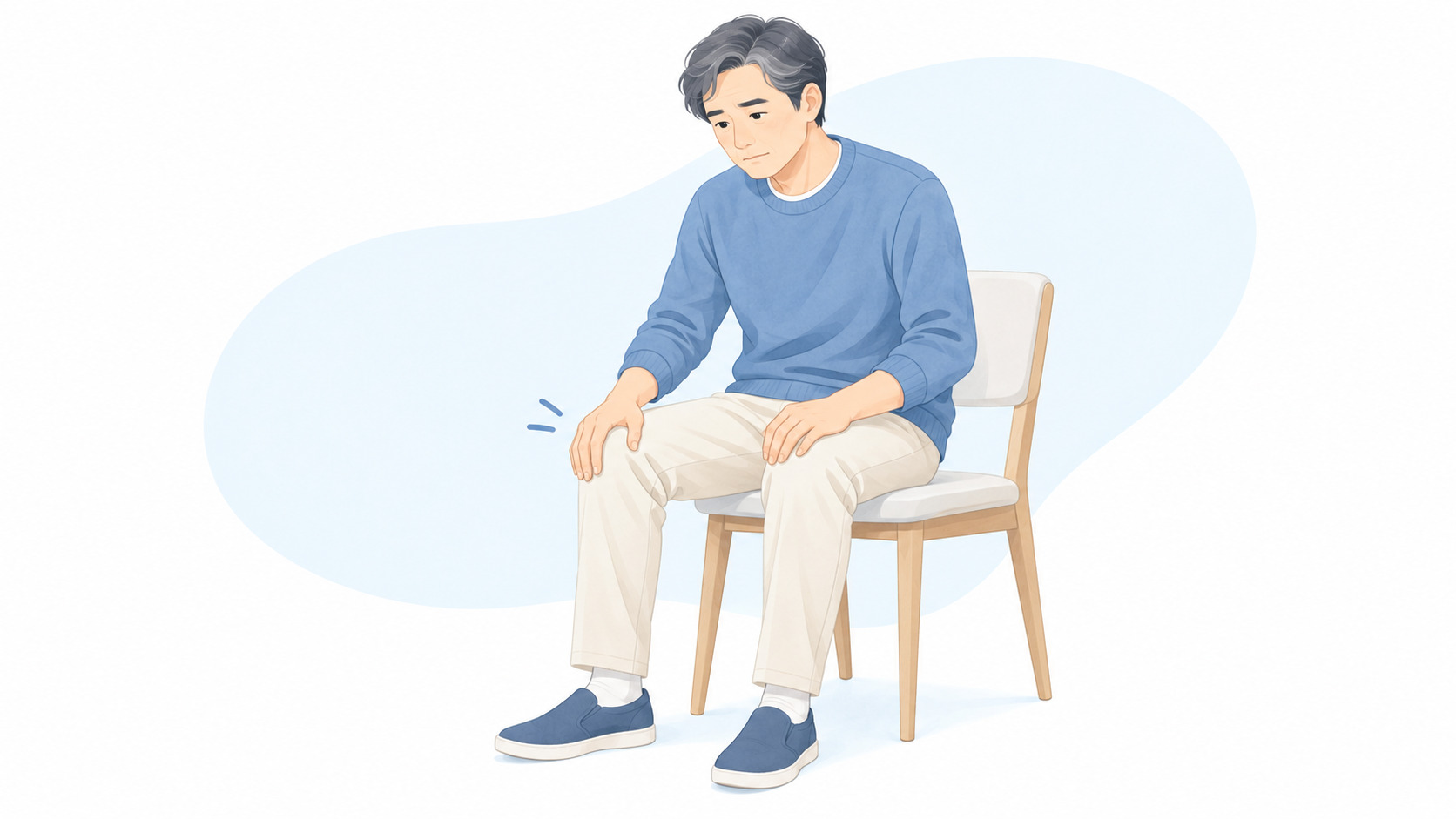
K-003 Symptoms That Accompany Knee Pain
Part 2: Catching, Locking, Giving Way and Sudden Swelling | Knee Symptoms to Pay Attention To
Medical review
In Part 1, we explained knee swelling, a buildup of fluid in the joint, warmth, redness and joint fluid.
In Part 2, we explain symptoms such as “My knee catches,” “Suddenly I cannot straighten my knee,” “My knee gives way,” “My knee makes a grinding sound,” and “My knee suddenly swelled up after an injury.”
11. When the knee catches
Some patients say, “It feels as though something is catching inside my knee when I bend or straighten it.”
In this situation, we consider whether something inside the joint may be interfering with movement. A common example is a meniscus tear. If part of a torn meniscus moves out of its normal position, it can cause a catching sensation when the knee bends or straightens. The menisci are the pads of cartilage that help cushion the knee.
A loose body, such as a fragment of bone or cartilage inside the joint, can also cause catching.
12. What is locking?
With some meniscus tears, the torn part moves into a position within the joint that physically blocks the knee from moving. This is called mechanical locking.
Typical symptoms include suddenly being unable to straighten the knee, the knee stopping at a particular angle, or a feeling that something is trapped inside.
Severe pain or muscle tension can also make it difficult to move the knee. Being unable to straighten the knee does not always mean that a torn meniscus is trapped in the joint.
13. When it gradually becomes harder to straighten the knee
If the knee has gradually become harder to straighten, rather than suddenly becoming stuck, we consider stiffness in the joint itself.
As conditions such as knee osteoarthritis progress, straightening may be limited by tightening of the joint capsule, changes in bone shape, a buildup of joint fluid, or pain that restricts movement.
In particular, when the back of the joint capsule becomes tight, it can cause a pulling pain behind the knee.
14. When the knee does not bend deeply
There is also more than one possible reason why the knee will not bend far enough to sit back on the heels in the Japanese kneeling position, called seiza. We consider knee osteoarthritis, a buildup of joint fluid, joint contracture (stiffness that limits movement), and pain that restricts movement.
During the examination, we check how far the knee bends, whether pain occurs along the way, and whether it comes to a firm stop at the end of the movement.
15. When the knee suddenly gives way
Patients sometimes say, “My knee suddenly buckles when I am walking,” or “It feels as though my knee gives out.” These symptoms are sometimes described as giving way.
This is one symptom that can occur when the knee is unstable because of an injury to a ligament, such as the anterior cruciate ligament (ACL).
However, a ligament injury is not the only possible cause. The knee may also feel as though it is giving way when fluid or blood has collected in the joint and caused swelling, or when pain prevents the quadriceps muscles at the front of the thigh from working fully.
A knee that buckles does not necessarily have a cruciate ligament injury.
16. Grinding sounds or sensations
Some patients describe a grinding or rough sensation when they move the knee.
Knee osteoarthritis or an uneven cartilage surface in the patellofemoral joint, where the kneecap meets the thighbone, can cause a sensation of friction or a sound during movement.
However, a sound alone does not necessarily indicate a medical condition. What matters is whether there is also pain, swelling, catching or a loss of movement.
17. Snapping or clicking with catching: plica syndrome
If bending or straightening the knee causes catching along with a snapping or clicking sound, a fold in the joint lining, called a synovial plica, may be involved. This condition is commonly called tana syndrome in Japan.
If a plica thickens or becomes inflamed, it may catch as the knee moves, causing a sound or pain.
There are many possible reasons for knee noises, so plica syndrome cannot be diagnosed from a sound alone.
18. Rapid swelling within hours of an injury
If the knee rapidly becomes very swollen immediately after a sports injury or fall, or within a few hours, we consider bleeding inside the joint. This is called hemarthrosis.
Important causes of rapid hemarthrosis after an injury include an ACL injury, a fracture involving the joint, a kneecap dislocation, and an osteochondral injury, which affects cartilage and the bone beneath it.
If swelling develops more slowly from the following day onward, we consider not only bleeding but also inflammation of the joint lining after an injury and a buildup of joint fluid.
19. A meniscus injury can also cause bleeding
The meniscus is not entirely without blood vessels. Its outer edge has a blood supply.
For this reason, an injury to the outer part of the meniscus can cause bleeding.
However, compared with an ACL tear, an isolated meniscus injury is less likely to cause a large amount of bleeding into the joint immediately after the injury.
20. A kneecap dislocation can also cause rapid swelling
When the kneecap dislocates toward the outside of the knee, it can damage the medial patellofemoral ligament on the inner side of the knee, the joint capsule, or the cartilage and underlying bone.
This can cause bleeding inside the joint and swelling soon afterward.
If the kneecap has moved back into place on its own, the patient may not realize that it was dislocated.
This is why it is also important to ask about experiences such as “It felt as though my knee came out of place,” or “It swelled up very quickly immediately after I fell.”
21. Knee swelling that needs prompt medical assessment
We recommend seeking medical care promptly, rather than simply waiting to see what happens, if the knee is red and hot, there is a fever, swelling is sudden and marked, pain prevents you from putting weight on the leg, you can barely bend or straighten the knee, swelling develops rapidly after an injury, or severe pain begins suddenly.
In particular, an infection in the joint, called septic arthritis, needs to be ruled out when a joint is red and hot and there is a fever.
22. What do joint fluid tests look for?
If joint aspiration is performed because an infection or crystal-induced arthritis is suspected, the fluid withdrawn from the joint is tested.
The main tests include a cell count and differential (the number and types of cells present), Gram staining to look for bacteria, bacterial culture, and examination for crystals such as calcium pyrophosphate (CPP) or urate.
Identifying the organism responsible in the joint fluid is particularly important when diagnosing septic arthritis.
23. What do blood tests look for?
When acute inflammation is severe, blood tests are used to check markers of inflammation, such as the white blood cell count and C-reactive protein (CRP).
However, blood tests alone cannot confirm or completely rule out septic arthritis. We assess the findings from the joint examination, joint fluid tests and blood tests together.
24. Antibiotics when an infection is suspected
When septic arthritis is suspected, treatment is urgent.
Except in highly urgent situations such as sepsis, we collect joint fluid and blood samples for culture before starting antibiotics whenever possible. Giving antibiotics first can make it harder to identify the organism in a culture.
If sepsis or septic shock is suspected, starting treatment must not be unnecessarily delayed for testing.
25. How do we use X-rays and MRI?
When the knee swells rapidly after an injury, we first use X-rays to check for a fracture.
However, plain X-rays alone cannot adequately assess injuries to the ACL, posterior cruciate ligament, meniscus, cartilage, or cartilage and underlying bone.
We therefore consider MRI when the examination or history of injury suggests a ligament injury, a meniscus injury or a similar problem.
The choice between X-rays and MRI depends on the condition we suspect. Each test has a different role.
K-003 summary: Swelling, fluid and catching are clues to what is happening inside the knee
When assessing knee pain, important diagnostic clues include not only the severity of pain but also swelling, a buildup of fluid, warmth, redness, catching, locking, giving way, noises, and how quickly swelling develops after an injury.
It is particularly important not to overlook septic arthritis when a knee is red, hot and very swollen and there is a fever.
If the knee swells rapidly within a short time after an injury, we consider a significant ligament injury, a fracture or another injury that causes bleeding inside the joint.
At Goda Orthopedics, we combine the pattern of symptoms, the examination, joint fluid tests, blood tests, X-rays and, when needed, MRI to understand what is happening inside the knee.
Frequently asked questions about knee swelling, fluid and catching
Q1. Does fluid in the knee always need to be drained?
Not necessarily. The decision depends on the amount of fluid, the pain, the cause, and whether the fluid needs to be tested to help establish a diagnosis.
Q2. Does draining the fluid make it keep coming back?
Draining the fluid does not itself make the knee more likely to develop another buildup of fluid. If the cause of the extra fluid is still present, it may collect again.
Q3. Does cloudy joint fluid mean pseudogout?
Appearance alone cannot establish the diagnosis. Fluid may also be cloudy in crystal-induced arthritis, septic arthritis and inflammatory arthritis. Crystal analysis and culture are performed as needed.
Q4. Is a meniscus injury the reason my knee catches?
A meniscus injury is one possible cause, but there are others, including a loose body or a synovial plica.
Q5. Does giving way mean that I have an ACL injury?
Giving way can occur with instability caused by an ACL injury or a similar problem. However, fluid buildup or pain that prevents the muscles from working fully can cause similar symptoms.
Q6. Does a grinding sound mean that the cartilage is gone?
Changes in joint shape or uneven cartilage surfaces can cause sounds. However, the condition of the cartilage cannot be judged from sound alone.
Q7. Should I see a doctor if my knee swells immediately after an injury?
Yes. Rapid swelling within a short time may indicate bleeding inside the joint caused by an ACL injury, a fracture, a kneecap dislocation or another injury.
Q8. Is it safe to wait and see if my knee is red and hot?
Septic arthritis, crystal-induced arthritis or another condition may be responsible. Prompt medical assessment is needed, particularly if there is severe pain or a fever.
Related reading
About the medical review
This article is based primarily on Dr. Goda’s clinical experience and examination procedures in general orthopedic practice. It has been cross-checked against standard medical knowledge in orthopedics and rheumatology and edited for patients. It reflects points such as not diagnosing infection or calcium pyrophosphate deposition (CPPD) disease from the appearance of joint fluid alone; recognizing that finding CPP crystals does not completely rule out septic arthritis; recognizing that the outer edge of the meniscus has a blood supply; understanding that rapid swelling immediately after an injury suggests hemarthrosis; and the importance of prompt joint aspiration when septic arthritis is suspected.
Key references and medical resources
- Ravn C, et al. Guideline for management of septic arthritis in native joints (SANJO). Journal of Bone and Joint Infection. 2023;8:29–37. doi:10.5194/jbji-8-29-2023.
- AAOS OrthoInfo. Meniscus Tears.
- AAOS OrthoInfo. ACL Injury: Does It Require Surgery?
- AAOS OrthoInfo. Patellar Dislocation and Instability in Children (Unstable Kneecap).
- Johnson MW. Acute Knee Effusions: A Systematic Approach to Diagnosis. American Family Physician. 2000;61(8):2391–2400.
Reviewer profiles
Taketoshi Goda
Chairman, GOZEN Medical Corporation
Orthopedic specialist; Doctor of Medical Science
Takuro Sasaki
Director, Kita 7-jo Goda Orthopedics
Orthopedic specialist; Doctor of Medical Science; occupational physician; Japan Sport Association-certified sports doctor
Naoki Seito
Director, Iwamizawa Goda Orthopedics
Orthopedic specialist; Doctor of Medical Science; Japanese Society for Replacement Arthroplasty-certified physician; Japan Sport Association-certified sports doctor
Article information
Article number: K-003
Article title: Symptoms That Accompany Knee Pain | Swelling, Fluid, Warmth, Catching and Giving Way
Article section: Part 2 / Catching, locking, giving way and rapid swelling after an injury
Series: Goda Orthopedics’ Guide to Knee Pain
Medical review: Taketoshi Goda / Takuro Sasaki / Naoki Seito
English publication date:
Original Japanese publication date:
Original article: K-003 Part 2 (Japanese)


