


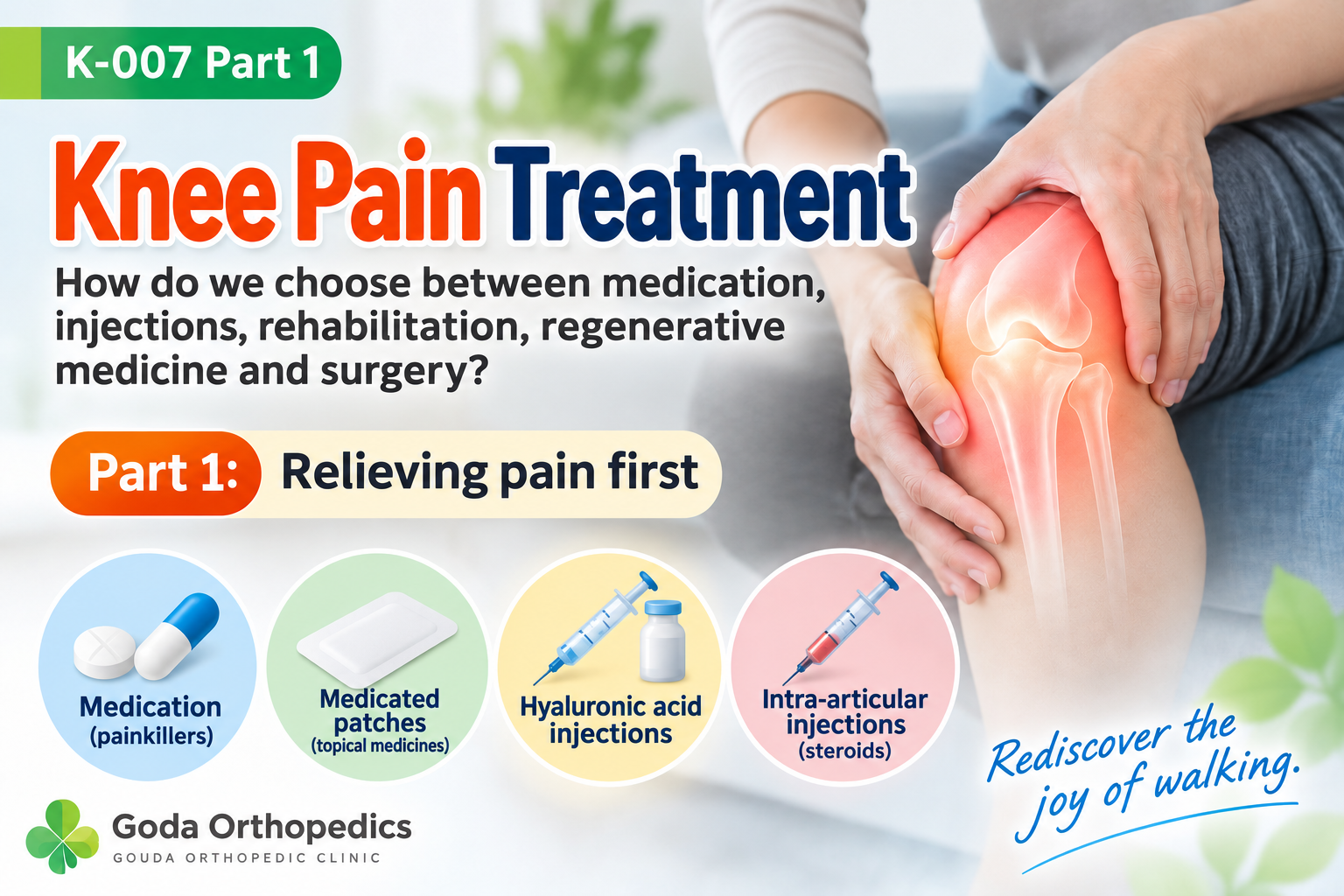
K-007 Knee Pain Treatment: How Do We Choose Between Medication, Injections, Rehabilitation, Regenerative Medicine and Surgery?
Part 1: Relieving Pain First | Medication, Medicated Patches, Hyaluronic Acid and Intra-articular Injections
Medical review
Treatment for a patient with knee pain does not end with simply saying, “First, strengthen your muscles,” “It is just your age, so there is nothing to be done,” or “Let us see how things go with painkillers.”
At Goda Orthopedics, when pain is severe, we place importance on relieving that pain first, regardless of whether the diagnosis is knee osteoarthritis, a meniscal injury or another condition.
However, this does not mean simply prescribing painkillers. First, we use a clinical examination, X-rays and, when necessary, MRI or other tests to clarify the cause of the pain as much as possible. We then combine medication, injections, rehabilitation, braces or other orthotic devices, and weight management according to that cause.
1. The first step in treatment is to find out why the knee hurts
Even when patients have the same symptom of knee pain, its cause varies from person to person.
Possible causes include knee osteoarthritis, meniscal injuries, joint effusion, synovitis, cartilage damage, ligament injuries and damage to the bone beneath the cartilage.
We therefore do not give everyone the same treatment simply because their knee hurts. Treatment differs depending on whether inflammation inside the joint is the main problem, alignment abnormalities play a major role, or muscle weakness is present.
2. When pain is severe, we actively work to relieve it
At Goda Orthopedics, we generally do not stop at telling patients, “Your knee hurts, so just rest.”
Severe pain can easily lead to a vicious cycle: patients cannot walk, exercise or participate in rehabilitation, their muscles weaken, and movement becomes even more difficult.
We therefore aim to help patients regain as much ability to move as possible while controlling pain with medication, injections and other measures.
3. NSAIDs are one option for oral medication
NSAIDs (nonsteroidal anti-inflammatory drugs) are among the main medicines used for knee pain. They reduce inflammation and pain and may be used, for example, during an acute episode of knee pain.
However, NSAIDs can cause gastrointestinal problems and affect kidney function and the cardiovascular system. We make decisions particularly carefully for older patients and those with reduced kidney function or gastrointestinal risk factors.
Oral NSAIDs are an effective option, but it is important to consider the patient's age and kidney, gastrointestinal and cardiovascular risks, and to limit their use to what is necessary.
4. Acetaminophen may also be used
We may consider acetaminophen for patients for whom NSAIDs are difficult to use, among others.
Although it is a relatively easy medicine to use, its pain-relieving effect for knee osteoarthritis may be limited.
We therefore do not prescribe acetaminophen to everyone simply because it appears safe. We choose medication based on the patient's age, existing medical conditions and severity of pain.
5. Medicated patches and topical medicines are also treatment options
Many patients ask us for medicated patches.
Some patches and topical medicines contain pain-relieving ingredients such as NSAIDs. Because they can be applied locally, topical NSAIDs are a medication option for knee osteoarthritis (OA).
However, patches can cause skin problems such as irritation, redness and itching. In such cases, we tailor treatment to the patient, for example by switching to a topical medicine that is applied directly to the skin.
6. “If I take painkillers, might I fail to notice that my knee is getting worse?”
Patients sometimes ask, “If painkillers take away the pain, won't I overuse my bad knee?”
For knee pain, it is usually unnecessary to think that taking painkillers in itself will conceal the underlying condition. Rather, they have a role in relieving pain so that patients can walk, carry out daily activities and participate in rehabilitation.
However, this does not mean continuing excessive exercise while suppressing pain with medication.
7. We may use an injection when we believe the cause lies inside the joint
When the cause of pain lies inside the joint, as in knee osteoarthritis, we may give an intra-articular injection.
At Goda Orthopedics, we may choose intra-articular hyaluronic acid injections, which are used as an insurance-covered treatment in Japan.
However, international guidelines differ in their assessment of hyaluronic acid. It is important not to regard it as a treatment that works for everyone, but to monitor each patient's response as it is used.
8. Steroids may be used when effusion or inflammation is pronounced
If a patient has severe pain, marked joint effusion or marked inflammation at the first visit, we may consider an intra-articular steroid after assessing the symptoms and underlying condition.
At Goda Orthopedics, when inflammation or effusion is pronounced initially, we may combine hyaluronic acid with a small amount of steroid at the first treatment, followed by hyaluronic acid alone.
Intra-articular steroid injections can provide short-term pain relief, but they are not a medication to be administered repeatedly at frequent intervals. We decide the timing and number of injections according to the patient's condition.
9. When a local anesthetic is used together with a joint injection
A local anesthetic may also be used with a joint injection.
The aims include reducing pain during the injection and making a viscous preparation easier to inject.
However, the effects of local anesthetics on cartilage are a subject of discussion and depend on the agent, concentration and duration of exposure. They should therefore not be used routinely inside the joint without careful consideration. We assess the need for each patient.
Part 1 summary: Treatment does not end with medication or injections alone
In treating knee pain, the following sequence is important: diagnose the cause of the pain → reduce pain with medication or injections → make movement easier → improve muscle strength, range of motion, weight and alignment.
Medication and injections are not the goal of treatment. They are also ways to reduce pain so that patients can move on to the next stage of treatment.
Continued in Part 2
Part 2 explains strength training with a focus on the quadriceps, range-of-motion exercises, walking, cycling and squats, weight management, insoles and supports, and the roles of PRP-FD (a freeze-dried preparation) and mesenchymal cell culture supernatant.
About the medical review
This article is based on Dr. Goda's actual knee treatment practices and clinical experience in general orthopedic care as its primary source. The medical descriptions of drug treatment and intra-articular injections have been checked against standard orthopedic and osteoarthritis guidelines and edited for patients.
Medical reviewer profiles
Chairman, GOZEN Medical Corporation / Orthopedic specialist / Doctor of Medical Science
Director, Kita 7-jo Goda Orthopedics / Occupational physician / Japan Sport Association-certified sports doctor
Director, Iwamizawa Goda Orthopedics / Orthopedic specialist / Doctor of Medical Science / Japanese Society for Replacement Arthroplasty-certified physician / Japan Sport Association-certified sports doctor
Article information
Article number: K-007
Article title: Knee Pain Treatment: How Do We Choose Between Medication, Injections, Rehabilitation, Regenerative Medicine and Surgery?
Part: Part 1 / Medication, Medicated Patches, Hyaluronic Acid and Intra-articular Injections
Series: Goda Orthopedics' Guide to Knee Pain
Medical review: Taketoshi Goda / Takuro Sasaki / Naoki Seito
Published: October 31, 2026
Updated: November 2, 2026
This article was translated from the original Japanese using AI. Not all staff at Kita 7-jo Goda Orthopedics are fluent in English, but we make every effort to communicate with you and help you feel understood.


