


K-002 When Does Your Knee Hurt? Possible Causes Based on Painful Movements
Part 2: Prolonged Walking, Running, Jumping, Twisting and Night Pain: Knee Pain That Needs Attention
Medical review
Part 1 discussed knee pain commonly encountered in daily life, including pain when starting to walk, standing up, using stairs or slopes, kneeling with your legs folded under you, and squatting.
Part 2 explains what we consider when symptoms include pain with prolonged walking, running, jumping, twisting, turning over in bed, or even at rest or at night.
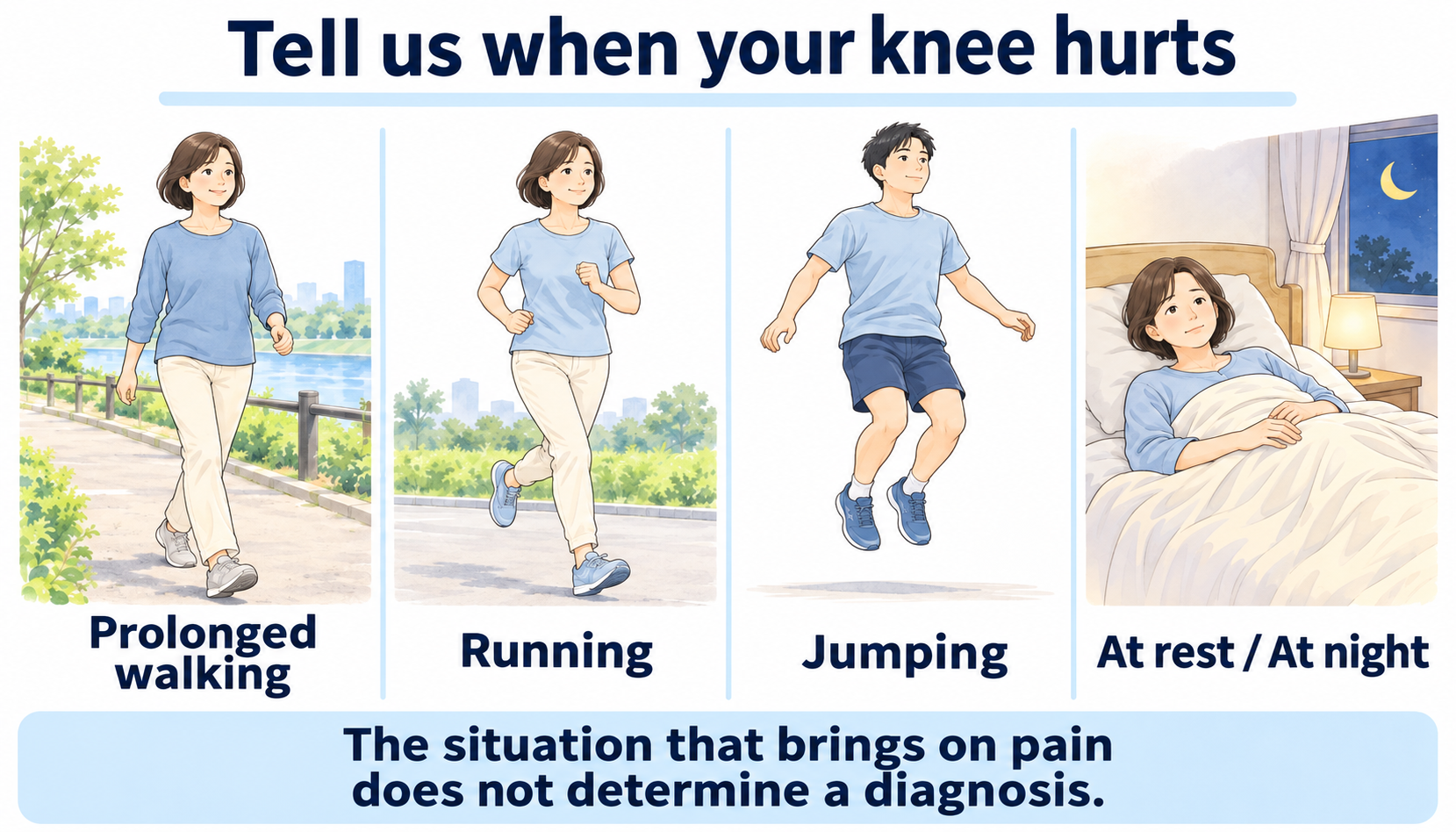
11. Knee pain after walking for a long time
When prolonged walking causes knee pain, we first consider conditions such as osteoarthritis in the knee itself.
However, we must not overlook symptoms originating in the lower back.
Conditions such as lumbar spinal stenosis may cause intermittent claudication: the leg starts to hurt after walking a certain distance, but you can walk again after resting.
We therefore check whether pain is localized to the knee or extends to the thigh or shin, whether there is numbness, whether simply stopping brings relief, and whether bending forward at the waist helps.
Pain after prolonged walking does not necessarily originate in the lower back. However, if symptoms develop according to the distance walked and improve with rest, the lower back also needs to be examined.
12. Knee pain when running
You may have no pain during ordinary walking but develop pain when running. In this situation, we consider that symptoms emerge only when the knee experiences greater impact or repeated loading than in daily life.
We therefore consider problems with the articular cartilage, subchondral bone, meniscus, patellofemoral joint, tendons, and other structures.
Changes in exercise volume are also important, such as recently taking up running or suddenly increasing the distance you run.
13. Pain when jumping: Jumper’s knee
When the front of the knee hurts in sports involving repeated jumping and landing, we consider patellar tendinopathy, also called jumper’s knee.
Jumper’s knee is seen particularly in sports with repeated jumping, such as basketball, volleyball, and track and field.
It is associated with repeated high loads on the patellar tendon. Pain typically occurs below the kneecap, around the patellar tendon.
It is important to know not just that jumping hurts, but also where pressing causes pain.
14. Pain when twisting the knee
When twisting the knee causes pain, a meniscal problem is one of the first possibilities we consider.
Twisting the knee while bearing weight places a load on the meniscus.
However, twisting at the time of injury can also be involved in injuries to ligaments such as the medial collateral, lateral collateral, anterior cruciate, or posterior cruciate ligament.
What matters is the direction in which the knee twisted and whether this happened during an injury or in an everyday posture.
15. Knee pain when sitting cross-legged or with both legs folded to one side
Sitting cross-legged or with both legs folded to one side applies not only bending and straightening forces but also rotational and inward or outward angling forces to the knee.
However, the way people sit varies.
We therefore cannot simply conclude that cross-legged sitting indicates a problem on the outer side or that sitting with the legs to one side indicates the inner ligament.
We check the actual limb position and exactly where in the knee the pain occurs.
During the examination, we consider loads on the meniscus, collateral ligaments, joint capsule, and other structures.
16. Knee pain when turning over in bed
Some people say, “It does not hurt when I am simply lying in bed, but my knee hurts the moment I turn over.”
When turning over, the weight of the leg may apply rotational and inward or outward angling forces to the knee.
If there is joint inflammation or a problem involving the meniscus, ligaments, joint capsule, or other structures, turning over may therefore trigger pain.
The important distinction is whether it hurts even while lying still or only at the moment of moving to turn over.
17. Knee pain even at rest
In many cases of knee osteoarthritis and similar conditions, pain increases with activities such as walking or standing up.
Severe pain even when the knee is not bearing weight therefore requires attention.
Of course, advanced knee osteoarthritis can also cause pain at rest.
However, if pain begins suddenly, is extremely severe, prevents sleep at night, or makes weight-bearing impossible despite no obvious injury, we also consider conditions other than ordinary osteoarthritis.
18. Insufficiency fractures can also cause pain at night
One condition to watch for in middle-aged and older people is a subchondral insufficiency fracture of the knee, or SIFK.
Small fractures can occur in the bone immediately beneath the joint surface even without a major fall.
SIFK may cause sudden knee pain, severe pain with weight-bearing, pain at rest, and pain at night.
Moreover, early abnormalities may not be apparent on plain X-rays.
For this reason, we consider MRI when a middle-aged or older person develops sudden severe knee pain and symptoms remain strong even though X-rays show no major abnormality.
19. Osteonecrosis is also a diagnostic consideration
Problems inside the bone can also cause severe knee pain. Osteonecrosis is one such condition.
However, some conditions previously called “spontaneous osteonecrosis of the knee” are now thought to include conditions that progressed from subchondral insufficiency fractures.
We therefore now distinguish and evaluate subchondral insufficiency fractures, osteonecrosis, and other bone abnormalities using imaging and other findings. This is a situation in which MRI becomes important.
20. When there is fever, redness, or marked swelling
If the knee is not only painful but clearly red, warm, or markedly swollen, or if there is fever or a sudden inability to move it, we consider severe inflammation.
Infectious arthritis and crystal-induced arthritis, among other conditions, need to be considered in the differential diagnosis.
A suddenly painful, hot or markedly swollen joint needs urgent medical assessment the same day, even without a fever. Joint infection can occur without fever and should not be treated as ordinary osteoarthritis and simply watched.
21. Do not overlook tumors when there is night pain
Although they are not common, tumors must not be overlooked in orthopedic practice.
Bone and soft-tissue tumors enter the differential diagnosis particularly when there is severe pain even at rest, persistent night pain, gradually worsening pain, unexplained swelling, or symptoms that are difficult to explain as a usual knee condition.
Night pain alone does not mean a tumor, but pain that differs from typical weight-bearing pain needs attention.
Arrange a medical appointment for night pain that persists or worsens. Night pain alone does not automatically mean a tumor or an emergency; sudden severe pain, inability to bear weight, or a hot swollen joint needs more urgent assessment.
22. When the pain occurs is not enough to make a diagnosis
Patients sometimes ask, “Does pain on stairs mean it is my meniscus?” or “Does pain on standing up mean knee osteoarthritis?”
However, movement alone cannot establish a diagnosis.
At Goda Orthopedics, we first ask the patient where it hurts.
However, patients quite often describe the whole knee as painful.
In that case, the doctor palpates areas such as the inner and outer joint lines, patellofemoral joint, patellar tendon, and back of the knee to find where there is tenderness.
23. The pattern of swelling also offers diagnostic clues
When the knee is swollen, we consider what is causing the swelling.
Synovitis, involving inflammation throughout the joint, and joint effusion, in which excess fluid collects inside the joint, may feel different during examination.
When a large amount of fluid is present, a fluid wave may be felt.
We also check for warmth, redness, and the location of the swelling.
24. We also check bending, straightening, and instability
Next, we actually move the knee.
We look at whether it straightens fully, how far it bends, and whether pain occurs partway through bending.
We also assess instability in the inward and outward angling directions and the front-to-back direction.
If there is a history of injury, we also consider ligament damage. Hands-on tests such as the McMurray test are performed when needed.
25. Age alone does not determine the diagnosis
Age is also important information.
Severely advanced age-related knee osteoarthritis is generally not common in young people.
However, we cannot say that a young person cannot have knee osteoarthritis.
If someone experienced a meniscal injury, cruciate ligament injury, or major knee injury in their teens, secondary degenerative changes may progress even at a young age.
We therefore always consider age together with injury history.
26. We compare X-rays with the examination findings
X-ray findings are important as well as the clinical examination.
However, as explained in K-001, we do not make a diagnosis by looking at images alone.
We check whether X-ray findings correspond to pain location, the movements that cause symptoms, tenderness, range of motion, swelling, and instability.
Some patients have little pain despite marked degenerative changes on imaging. Conversely, some have severe pain despite only minor changes on X-rays.
27. Situations in which we actively consider MRI
MRI is not performed for every case of knee pain.
However, MRI is useful when we suspect a meniscal injury, ligament injury, subchondral insufficiency fracture, or a problem within the bone such as osteonecrosis, or when severe pain persists that cannot be explained by X-rays.
In particular, early SIFK abnormalities can be difficult to detect on X-rays, so MRI is considered important for early diagnosis.
K-002 summary: Painful movements are a message from your knee
When patients tell us that stairs hurt, that their knee hurts on getting up in the morning, that kneeling with the legs folded under them hurts, or that it hurts only when running, they provide important diagnostic information.
Knowing the movement helps us consider which tissue hurts, the direction of the force applied, and how much force brings on the pain.
However, more than one condition can cause pain with the same movement.
At Goda Orthopedics, diagnosis combines painful movements, pain location, swelling and effusion, range of motion, tenderness, instability, age and injury history, and X-rays, with MRI when needed.
“When does it hurt?” is not the answer to the diagnosis, but an important starting point for getting closer to the cause.
Frequently asked questions about movement-related knee pain
Q1. Is pain only when starting to walk a sign of knee osteoarthritis?
It can occur with knee osteoarthritis, but other problems within the joint, such as those involving the meniscus or subchondral bone, can also hurt when weight-bearing begins. We assess pain location together with examination findings and imaging.
Q2. What do you consider when going upstairs hurts?
We consider the patellofemoral joint, quadriceps, patellar tendon, knee osteoarthritis, and other possibilities. It is important to check where there is tenderness.
Q3. Does pain going downstairs mean a meniscal injury?
Meniscal problems are one possible cause, but knee osteoarthritis and patellofemoral pain can also cause pain on descent. Movement alone cannot determine the diagnosis.
Q4. Why does kneeling with the legs folded under you or squatting hurt?
Deep knee bending increases loads on the patellofemoral joint, the rear part of the meniscus, altered joint surfaces, and tissues behind the knee. The conditions we consider vary with the location of the pain.
Q5. My knee hurts after prolonged walking. Could my lower back be the cause?
Yes. Problems in the knee itself can cause pain with prolonged walking, but if leg pain or numbness develops after a certain distance and improves with rest, we also consider lumbar spinal stenosis and similar conditions.
Q6. If it hurts only when running, can I continue exercising?
That depends on the cause and severity of the pain. Even when symptoms occur only while running, an underlying problem may involve the cartilage, meniscus, patellofemoral joint, or tendons. It is important to identify the cause before pushing through pain and increasing the load.
Q7. Is knee pain at night dangerous?
Night pain alone does not necessarily indicate a serious condition. However, when it accompanies severe pain at rest, sudden onset, difficulty bearing weight, fever, or swelling, we evaluate possibilities including insufficiency fracture, inflammation, osteonecrosis, and tumors.
Q8. Is MRI sometimes performed even when X-rays are normal?
Yes. Meniscal or ligament injuries, subchondral insufficiency fractures, and osteonecrosis may not be adequately identified on plain X-rays alone. We consider MRI according to symptoms and examination findings.
Related Articles
- Where Does Your Knee Hurt? Part 1: Front, Inner and Outer Knee Pain
- Knee Pain with Movement: Stairs and Standing Up
- How Doctors Examine and Diagnose Knee Pain
- L-004: What Is Lumbar Spinal Stenosis? Part 1 (Japanese)
About the medical review
This article is based primarily on Dr. Goda’s clinical experience and examination procedures in general orthopedic practice. It does not represent an opinion offered as a knee subspecialist.
Medical statements about diagnosis, movement-related pain, patellar tendinopathy, subchondral insufficiency fractures, osteonecrosis, and imaging were checked against standard orthopedic and sports medicine literature and clinical guidelines and edited for patients.
In particular, the article treats jumper’s knee as patellar tendinopathy and reflects that subchondral insufficiency fractures of the knee (SIFK) may not show clear abnormalities on early plain X-rays, and that some conditions previously called “spontaneous osteonecrosis of the knee” are thought to lie on a continuum with SIFK.
Main references and academic resources
- Osteoarthritis in over 16s: diagnosis and management (NG226).
- Bunt CW, Jonas CE, Chang JG. Knee Pain in Adults and Adolescents: The Initial Evaluation. Am Fam Physician. 2018;98(9):576-585.
- Ochi J, et al. Subchondral insufficiency fracture of the knee: review of current concepts and radiological differential diagnoses. Jpn J Radiol. 2022.
Additional safety reference: NHS: Septic arthritis.
Reviewer profiles
Chairman, GOZEN Medical Corporation
Orthopedic specialist; Doctor of Medical Science
Director, Kita 7-jo Goda Orthopedics
Orthopedic specialist; Doctor of Medical Science; occupational physician; Japan Sport Association-certified sports doctor
Director, Iwamizawa Goda Orthopedics
Orthopedic specialist; Doctor of Medical Science; Japanese Society for Replacement Arthroplasty-certified physician; Japan Sport Association-certified sports doctor
Article information
Article number: K-002
Article title: When Does Your Knee Hurt? Possible Causes Based on Painful Movements
Part: Part 2 / Prolonged walking, running, jumping, twisting, pain at rest, and night pain
Series: Goda Orthopedics’ Guide to Knee Pain
Medical review: Taketoshi Goda / Takuro Sasaki / Naoki Seito
Original Japanese publication date: Thursday, October 15, 2026
Goda Orthopedics
This article was translated from the original Japanese using AI. Not all staff at Kita 7-jo Goda Orthopedics are fluent in English, but we make every effort to communicate with you and help you feel understood.


