


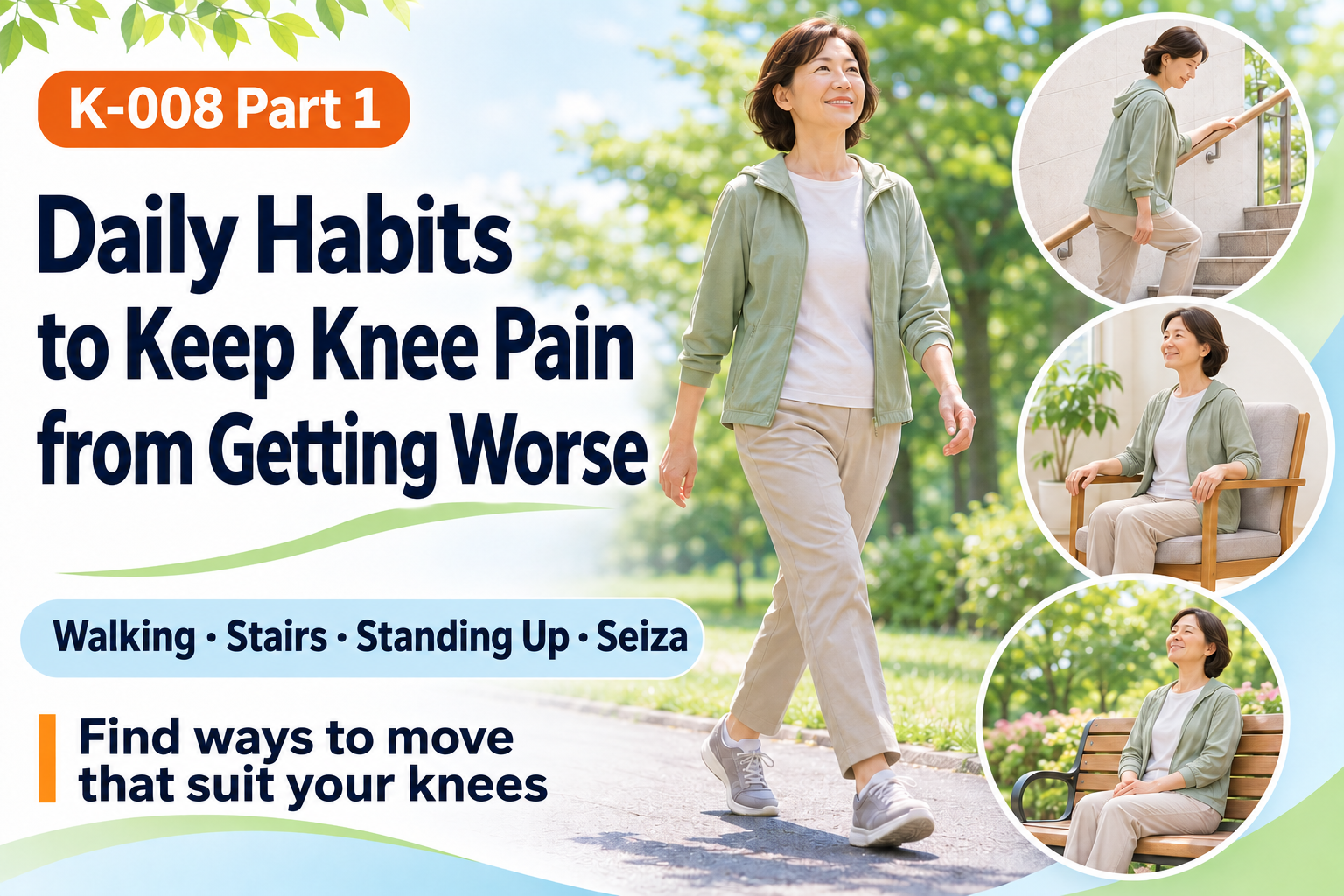
K-008 Daily Habits to Keep Knee Pain from Getting Worse | Walking, Stairs, Exercise and Weight Management
Part 1: Changing Everyday Movements | Walking, Stairs, Standing Up and Seiza
Medical review
When their knees hurt, many people worry, “Would it be better to walk as little as possible?” or “Will exercise wear away even more cartilage?”
However, we do not advise every patient to rest simply because they have knee pain.
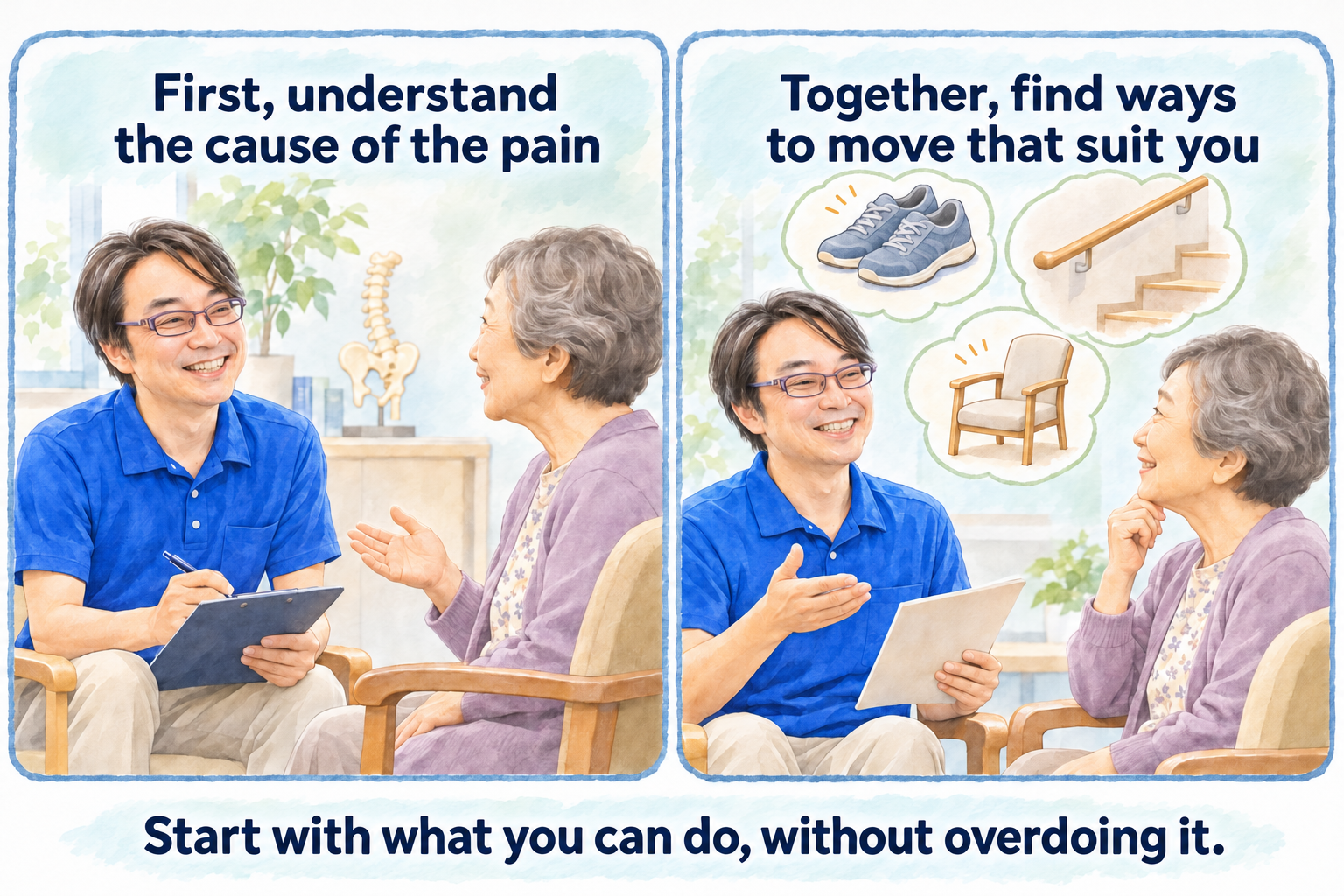
What matters is finding out why the knee hurts and choosing ways to move that suit the underlying condition.
In this article, we explain everyday habits that may help avoid making knee symptoms worse, focusing mainly on knee osteoarthritis, a particularly common condition.
1. Everyday advice for knee pain depends on the diagnosis
The symptom “my knee hurts” alone is not enough to decide on one set of advice for daily life.
Is the cause knee osteoarthritis, a meniscus injury, a ligament injury or a fracture? Both the movements to avoid and the exercises we recommend depend on the cause.
At Goda Orthopedics, we first assess the following points and then consider advice suited to each patient:
- Where the knee hurts
- Which movements cause pain
- Swelling or warmth
- Changes in the shape or alignment of the knee
- The joint’s range of motion
- Muscle strength
- X-ray and MRI findings
The information in this article also describes general approaches mainly for knee osteoarthritis.
2. With knee osteoarthritis, take care when keeping the knee deeply bent
In some situations, the load on the joint increases as the knee bends more deeply. If you have pain from knee osteoarthritis, the following activities may therefore make your symptoms worse:
- Squatting for long periods
- Seiza, the Japanese kneeling position in which you sit back on your heels
- Working with the knees kept deeply bent
- Sitting cross-legged for long periods
Does this mean seiza is completely off limits?
It does not necessarily mean that you must never sit in seiza.
The problem is forcing yourself to keep the knee deeply bent for a long time despite pain.
If seiza or squatting causes pain, do not force yourself to continue.
3. Shifting your weight outward to avoid pain is not always the right approach
Many Japanese patients with knee osteoarthritis also have varus alignment, commonly called bow legs, in which the knees bow outward.
Patients with pain on the inner side of the knee may unconsciously shift their weight outward as they walk to avoid the pain. However, making major changes to your walking pattern on your own is not necessarily good for your knees.
At Goda Orthopedics, we assess the degree of varus alignment and the patient’s walking posture. When appropriate, we may offer individual guidance, for example on a walking pattern that focuses on bringing weight-bearing back toward the inner side.
However, the way a change in walking pattern affects the load on the knee varies from person to person. We cannot recommend one particular way of walking to every patient.
Rather than deciding on your own, “I have bow legs, so I should put a lot of weight on the big-toe side of my foot,” it is important to have your actual alignment assessed.
4. Pay attention to the direction of your knees on stairs
Stairs place more load on the knees than walking on level ground. When going down stairs in particular, the quadriceps muscles at the front of the thigh work to support the body. This can make symptoms more likely in patients with knee osteoarthritis or pain in the patellofemoral joint, where the kneecap meets the thighbone.
In patients with pronounced varus alignment, we also check whether the knees bow even farther outward when using stairs. Depending on the situation, the following adjustments may help:
- Use a handrail.
- Go up and down slowly.
- Keep your knees and toes pointing in the same direction.
- Do not push yourself on days when the pain is severe.
5. Avoid chairs that are too low when standing up
Getting up from a chair or sofa can place a surprisingly large demand on painful knees.
The lower the seat, the more deeply the knees need to bend and the more muscle strength is required to stand up. A low sofa can place a load on the lower back as well as the knees.
If you have knee pain, the following adjustments may help:
- Use a slightly higher chair.
- Avoid sofas that you sink deeply into.
- Use armrests if needed.
- Do not stand up abruptly.
At Goda Orthopedics, for patients with pronounced varus alignment, we may also assess knee alignment and provide individual guidance on foot spacing and the direction of the knees when standing up.
6. We do not recommend giving up walking simply because your knees are painful
Some people with knee pain try to walk as little as possible.
However, drastically reducing activity can create a cycle: muscles become weaker, walking becomes more difficult, and activity decreases even further.
For knee osteoarthritis, exercise therapy, including strengthening and aerobic exercise, is one of the main components of treatment.
If walking does not cause significant pain, there is no need to prohibit walking itself.
However, in the following situations, the amount of exercise needs to be reviewed and the cause investigated:
- The pain increases the more you walk.
- Significant pain persists for a long time after walking.
- The knee becomes markedly swollen.
- You suddenly become unable to walk.
7. On days with a lot of walking, do not expect to move exactly as you did when you were younger
It is important to keep enjoying travel, shopping and walks as you get older. However, the body does not move in exactly the same way as it did when you were younger.
On days when you will be walking a long distance, keep these points in mind:
- Do not set off too fast.
- Start moving slowly.
- Take breaks along the way.
- Do not push on after you become tired.
- Rest before the pain becomes severe.
This does not mean becoming inactive because of your age. It means learning ways to move that suit your body as it is now.
8. Should you cool the knee or warm it?
Patients ask this question very often. The answer depends on the condition of the knee.
When the knee is swollen and warm
If the knee has suddenly swollen, feels warm or is very inflamed, brief cooling may ease the symptoms.
However, marked redness, severe pain, fever or rapidly developing swelling may indicate infectious arthritis, crystal-induced arthritis or another condition. Do not simply cool the knee and wait to see what happens. Seek care at an orthopedic clinic.
Chronic pain or stiffness
Many patients with chronic knee osteoarthritis say, “A bath makes it feel better,” or “My knee feels better on days when I visit a hot spring.”
If warmth, such as a bath, feels soothing for chronic pain or stiffness, it is reasonable to include it in your routine.
Reviewer profiles
Taketoshi Goda
Chairman, GOZEN Medical Corporation
Orthopedic specialist; Doctor of Medical Science
Takuro Sasaki
Director, Kita 7-jo Goda Orthopedics
Orthopedic specialist; Doctor of Medical Science; occupational physician; Japan Sport Association-certified sports doctor
Naoki Seito
Director, Iwamizawa Goda Orthopedics
Orthopedic specialist; Doctor of Medical Science; Japanese Society for Replacement Arthroplasty-certified physician; Japan Sport Association-certified sports doctor
Article information
Article number: K-008
Article title: Daily Habits to Keep Knee Pain from Getting Worse | Walking, Stairs, Exercise and Weight Management
Article section: Part 1 / Everyday movements: walking, stairs, standing up and seiza
Series: Goda Orthopedics’ Guide to Knee Pain
Medical review: Taketoshi Goda / Takuro Sasaki / Naoki Seito
Original Japanese publication date:
English publication date:
Original article: K-008 Part 1 (Japanese)


