


K-004 Should I See a Doctor for This Knee Pain? Pain You May Be Able to Monitor and Pain That Needs Prompt Medical Attention
Part 1: Knee Pain That Needs Urgent Medical Assessment | Inability to Walk, Sudden Swelling and Warmth
Medical review
“My knee hurts, but is it bad enough to see a doctor?”
“Would it be all right to wait and see for a few days?”
Many patients with knee pain are unsure how to make this decision.
Not all knee pain requires a visit to an orthopedic clinic that same day.
However, some knee pain should be assessed promptly rather than monitored at home.
At Goda Orthopedics, we do not decide how urgently someone needs to seek care simply by how many days the knee has hurt. We consider whether the person can walk, whether symptoms began suddenly, whether there was significant trauma, whether swelling is developing rapidly, whether warmth or redness is present, and whether symptoms are getting worse.
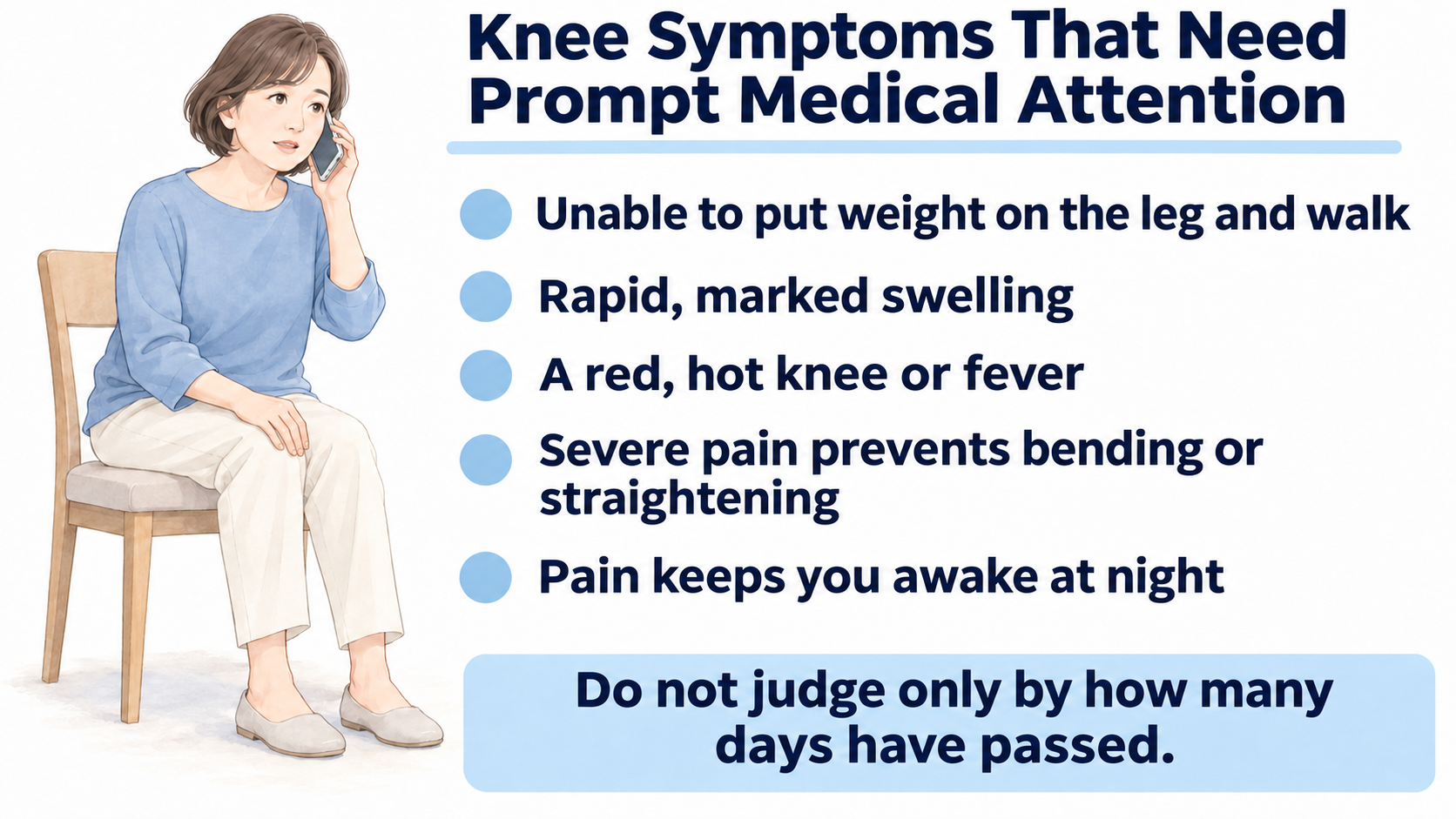
1. The most important question is whether you can bear weight and walk
When deciding whether to seek care for knee pain, the first important question is whether you can put weight on the affected leg and walk.
If the pain is so severe that you cannot put your foot down, cannot walk even a few steps, or cannot support yourself on that knee, this is different from ordinary chronic knee pain.
Prompt assessment is needed to check for possible causes such as a fracture, dislocation, serious ligament injury, or an injury to the cartilage and underlying bone.
After an acute knee injury, being unable to take four weight-bearing steps is one of the criteria used when considering X-rays.
A knee that is too painful to walk on is not something to monitor at home for days.
2. Pain after significant trauma
The next important consideration is how substantial the injury was.
If severe knee pain develops after an event involving considerable force, such as a forceful twist during sport, a hard collision with another player, a fall from a height, a traffic accident, or a hard blow to the knee, there may be a fracture or ligament injury that cannot be identified from appearance alone.
Being able to walk despite the pain does not necessarily mean that the injury is minor.
3. Marked swelling develops quickly after an injury
If the knee becomes very swollen within a few hours after a fall or sports injury, we consider the possibility of bleeding inside the joint.
Typical causes include an anterior cruciate ligament (ACL) injury, kneecap dislocation, a fracture involving the joint, or an injury to the cartilage and underlying bone.
A rapid buildup of joint fluid after an acute injury is an important clue that there may be damage inside the joint.
In particular, we recommend seeking care as soon as possible when significant trauma, rapid swelling and an inability to walk occur together.
4. The knee is red, swollen and hot to the touch
Prompt medical attention is also needed if the knee is red, clearly warm, markedly swollen or very painful even though there has been no injury.
Crystal-induced arthritis, such as pseudogout, can cause these symptoms.
However, the condition that needs particular attention is infectious arthritis, also called septic arthritis.
Infectious arthritis occurs when bacteria or other germs enter the joint and cause severe inflammation. Delays in diagnosis or treatment can lead to joint damage and, in severe cases, sepsis.
If infectious arthritis is suspected, joint fluid is collected and assessed as soon as possible.
5. Knee pain is accompanied by a fever
A fever along with knee pain also needs attention.
Possible causes include infectious arthritis, acute crystal-induced arthritis such as pseudogout, and inflammatory diseases that affect the body more broadly.
In particular, a red, hot, markedly swollen knee together with a fever should not be treated as ordinary knee osteoarthritis and simply monitored at home.
6. You can barely bend or straighten the knee
We also recommend prompt assessment if severe pain makes it difficult to bend or straighten the knee.
Possible causes include a large joint effusion (a buildup of joint fluid), blood in the joint, a fracture, locking caused by the meniscus or another structure, and severe inflammation.
After an acute injury, being unable to bend the knee to 90 degrees is also one of the findings that can help inform assessment for a fracture.
7. The knee is completely locked and will not move
If the knee suddenly becomes stuck at a particular angle or cannot be straightened because something feels trapped inside, we consider mechanical locking.
A meniscus injury is one common cause.
This needs to be distinguished from being unable to move because of pain. However, if something is truly trapped and preventing the knee from moving, prompt assessment at an orthopedic clinic is needed.
8. Pain keeps you awake at night
Night pain alone does not necessarily mean that there is a serious disease. Advanced knee osteoarthritis can also cause night pain.
However, if the pain began suddenly, is getting worse each day, remains severe at rest, prevents sleep, or is accompanied by swelling or fever, the cause needs to be investigated. Possible causes include a subchondral insufficiency fracture, severe inflammation, osteonecrosis, infection and a tumor-related lesion.
9. What if a serious injury happens outside clinic hours?
Injuries can happen in the evening or at night, for example during school sports. By then, regular orthopedic clinic hours may already have ended.
Consider seeking care at an emergency medical facility if you cannot bear weight and walk, the knee is becoming very swollen, there has been significant trauma, the knee looks deformed, or severe pain continues.
Emergency care first checks for urgent problems such as a fracture or dislocation and provides initial treatment, such as immobilization and pain relief, as needed.
After this, it is important to have a detailed orthopedic assessment as soon as possible, from the following day onward.
10. Emergency care and orthopedic care have different roles
Emergency care focuses first on checking whether there is an illness or injury that needs immediate attention.
A detailed assessment of the meniscus, ligaments, cartilage and other structures may require MRI or other tests.
Depending on staffing, available services and the time of day, an emergency medical facility may not be able to perform an MRI during that visit.
Even in that situation, it is important to have the cause investigated in more detail at an orthopedic clinic after receiving initial treatment.
Part 1 summary: Do not wait and see if you cannot walk on the knee
- You cannot bear weight and walk.
- You have sustained significant trauma.
- Marked swelling has developed rapidly.
- The knee is red and hot.
- You also have a fever.
- Severe pain prevents you from bending or straightening the knee.
- The knee is completely locked and will not move.
- Severe night pain prevents sleep.
- Symptoms are getting rapidly worse from day to day.
In particular, being unable to bear weight and walk is an important sign that you should not postpone seeking care.
About the medical review
This article is based primarily on Dr. Goda’s clinical experience and decisions about seeking care in general orthopedic practice. It does not present a specialist opinion from a knee specialist. It has been cross-checked against standard orthopedic and emergency medicine knowledge and edited for patients, including points such as inability to walk, marked swelling and restricted movement after an acute knee injury, and arthritis accompanied by fever and redness.
Key references
The following references were added for the English translation to support the discussion of acute knee injuries and suspected joint infection. They were not listed in the original Japanese article.
- NSW Agency for Clinical Innovation. Ottawa knee rules (adult). Published December 2023.
- Ravn C, et al. Guideline for management of septic arthritis in native joints (SANJO). Journal of Bone and Joint Infection. 2023;8:29–37. doi:10.5194/jbji-8-29-2023.
Reviewer profiles
Taketoshi Goda
Chairman, GOZEN Medical Corporation
Orthopedic specialist; Doctor of Medical Science
Takuro Sasaki
Director, Kita 7-jo Goda Orthopedics
Orthopedic specialist; Doctor of Medical Science; occupational physician; Japan Sport Association-certified sports doctor
Naoki Seito
Director, Iwamizawa Goda Orthopedics
Orthopedic specialist; Doctor of Medical Science; Japanese Society for Replacement Arthroplasty-certified physician; Japan Sport Association-certified sports doctor
Article information
Article number: K-004
Article title: Should I See a Doctor for This Knee Pain? Pain You May Be Able to Monitor and Pain That Needs Prompt Medical Attention
Article section: Part 1 / Knee pain that calls for urgent medical assessment
Series: Goda Orthopedics’ Guide to Knee Pain
Medical review: Taketoshi Goda / Takuro Sasaki / Naoki Seito
English publication date:
Original Japanese publication date:
Original Japanese update date:
Original article: K-004 Part 1 (Japanese)


