


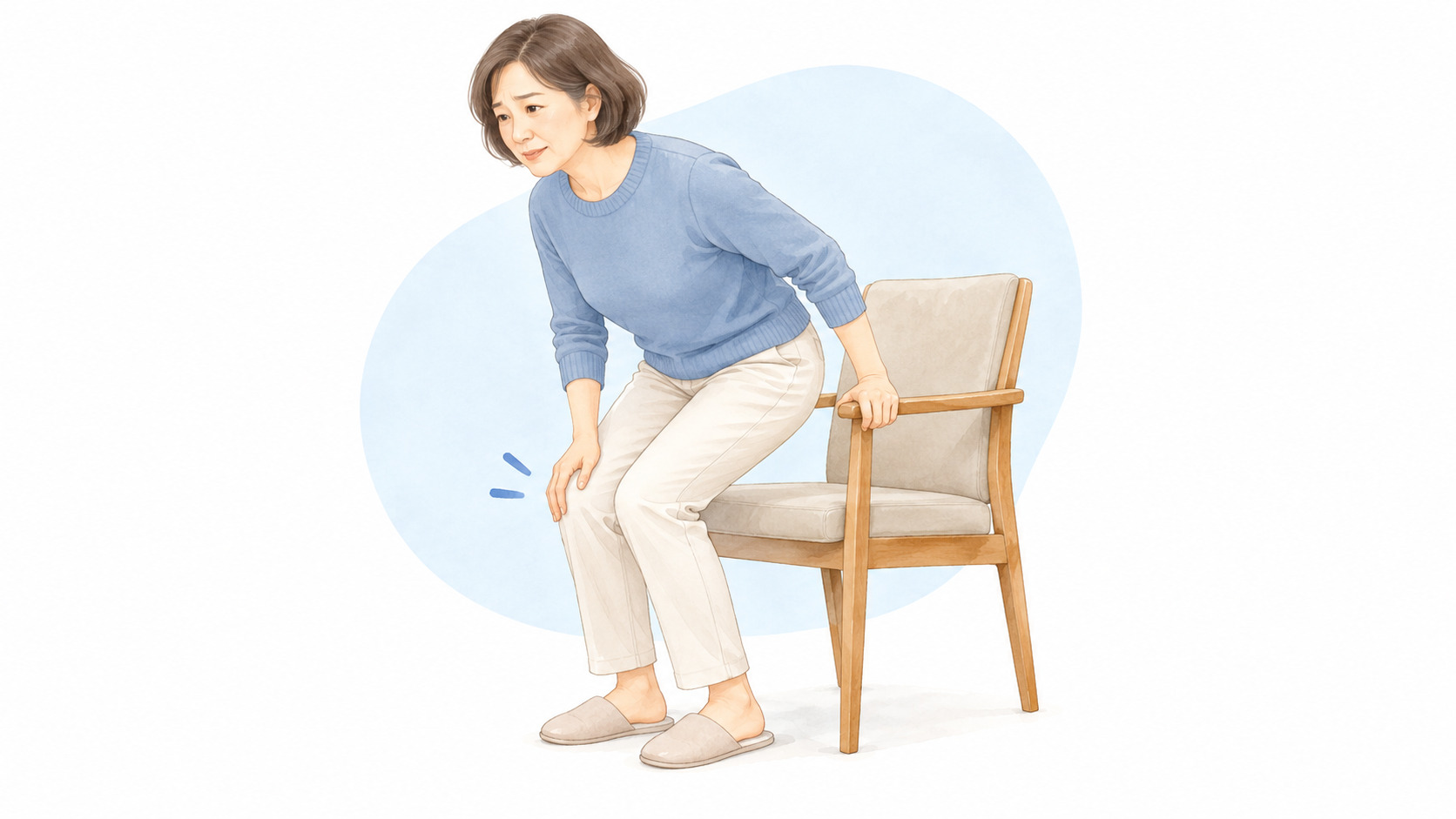
K-002 When Does Your Knee Hurt? Possible Causes Based on Painful Movements
Part 1: Pain When Starting to Walk, Using Stairs, Standing Up, Kneeling with Your Legs Folded Under You, or Squatting
Medical review
Although patients may all say that their knee hurts, the situations in which pain occurs differ from person to person.
Some people feel pain only during their first few steps after getting up in the morning. Others have pain going upstairs, going downstairs, rising from a chair, or only when bending the knee deeply.
In orthopedics, which movements cause pain is as important a diagnostic clue as where it hurts.
This is because the forces applied to the knee, the muscles used, and the parts of the joint under compression change with each movement.
However, a diagnosis cannot be made from movement alone, such as concluding that pain on stairs means a particular disease or that pain on standing up means knee osteoarthritis.
At Goda Orthopedics, we consider the cause by combining information about painful movements, pain location, swelling, joint effusion, range of motion, tenderness, instability, injury history, age, X-rays, and other findings.
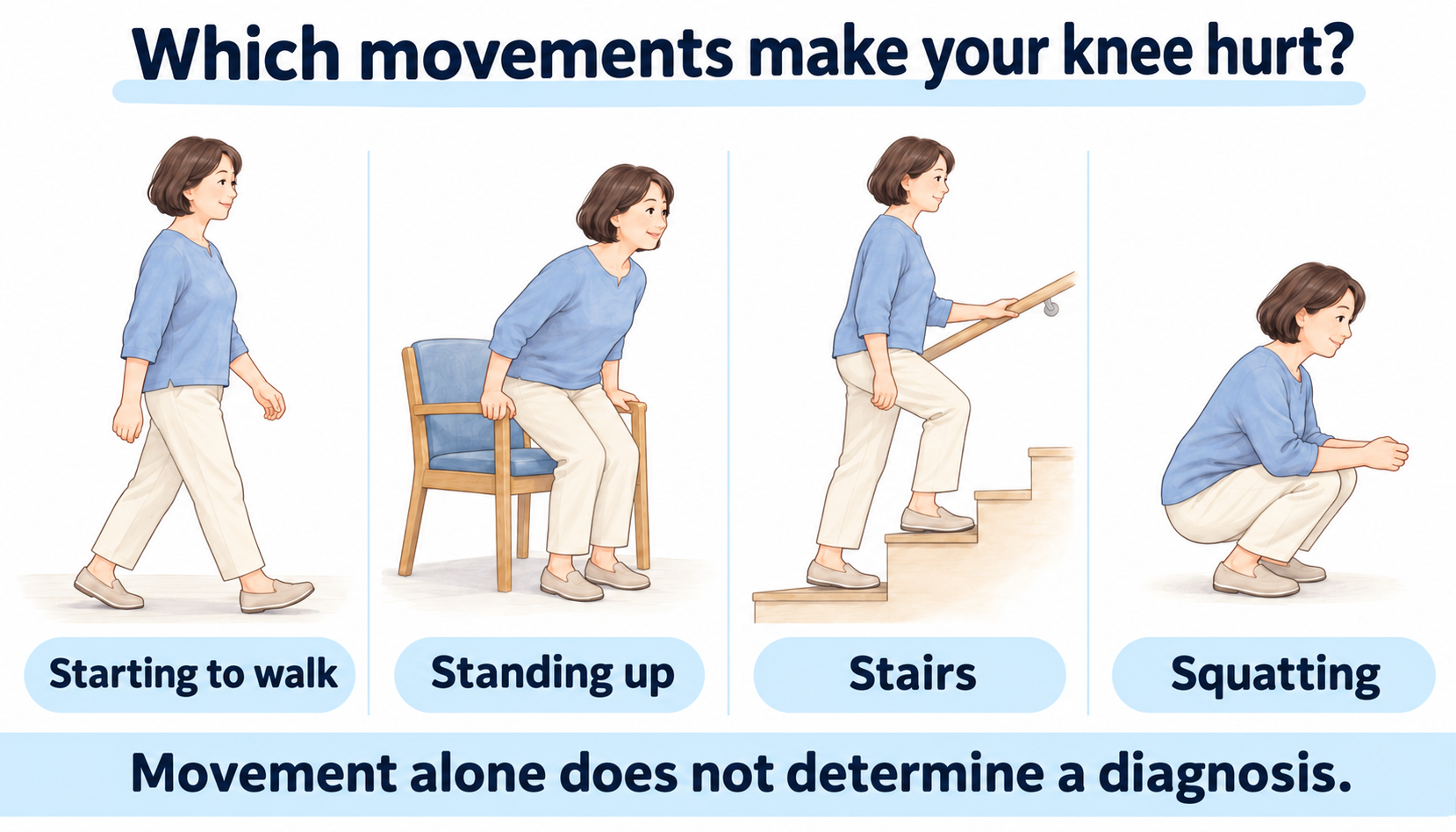
1. Knee pain when you start walking
“My first few steps after standing up hurt.” This is a common complaint among patients with knee pain.
While you are sitting, the knee is not bearing a large load. When you stand up, your body weight is suddenly applied to it.
For this reason, pain when starting to walk leads us to consider conditions within the knee joint that cause symptoms under load, such as knee osteoarthritis, meniscal degeneration or injury, and problems involving cartilage or the bone beneath it.
Especially in middle-aged and older people, knee osteoarthritis can cause pain or stiffness when first moving after a period of rest.
2. Pain during the first few steps after getting up in the morning
The situation just after waking is similar to that after sitting for a long time.
Because the knee usually moves relatively little during sleep, the joint may feel stiff when you first start moving after getting up.
Some middle-aged and older people say, “It hurts at first, but it gets a little easier after I bend and straighten it a few times.”
With symptoms like these, we consider joint stiffness, knee osteoarthritis, and other possibilities.
On the other hand, if morning stiffness lasts a very long time, or if several joints such as the fingers are swollen as well as both knees, we also need to consider inflammatory diseases other than osteoarthritis.
3. Pain on standing after sitting for a long time
Some people say their knee hurts the moment they stand up after sitting for a long time, such as at a cinema, in a meeting, or while driving.
There are two elements to this. One is starting to move a knee that has been still for a long time. The other is suddenly applying body weight to a knee that was not bearing weight.
We therefore consider knee osteoarthritis, problems with the patellofemoral joint, and problems with structures inside the joint, such as the meniscus.
Patellofemoral pain in particular may be triggered by prolonged sitting, stairs, squatting, or rising from a chair.
4. Pain when rising from a chair
To rise from a chair, you need not only to place your weight on the knee but also to use the quadriceps muscles to straighten it.
When standing up is painful, we therefore consider several possible causes, including knee osteoarthritis, meniscal problems, the patellofemoral joint, and the knee extensor mechanism.
The lower the chair, the more force is needed to rise from a deeply bent knee position.
In other words, it is important to establish not just that standing up hurts, but also the height from which you are rising and exactly where in the knee the pain occurs.
5. Knee pain when getting into or out of a car
Pain when getting into or out of a car is not uncommon.
The seat in a passenger car may be lower than an ordinary chair. Rising from a low position can place more strain on the knee than getting up from a normal chair because the knee bends deeply, the quadriceps work hard, and weight is applied at the moment of standing.
Also, twisting your body as you get out of a car may apply rotational force to the knee.
For pain when getting into or out of a car, we consider both the load involved in standing and the twisting movement.
6. Knee pain when going upstairs
When climbing stairs, you use the quadriceps muscles strongly to lift your body.
Because you exert force with the knee bent, the patellofemoral joint between the kneecap and thighbone is also loaded.
Pain when going upstairs therefore leads us to consider the patellofemoral joint, quadriceps muscles, patellar tendon, knee osteoarthritis, and other possibilities.
However, stair pain is not a symptom unique to the patellofemoral joint. It is important to identify the painful location by palpation.
7. Knee pain when going downstairs
Some patients say, “Going up is fine, but going down hurts.”
When descending stairs, the quadriceps act like a brake, supporting your body weight and preventing the knee from bending suddenly.
The knee joint and patellofemoral joint also bear substantial loads.
We therefore consider problems within the joint, such as knee osteoarthritis, meniscal problems, and patellofemoral pain.
We cannot link the symptom to a single diagnosis, such as assuming that pain going downstairs means a meniscal problem. For both ascending and descending stairs, we judge the cause together with pain location and examination findings.
8. Knee pain when walking uphill or downhill
Like stairs, slopes place more strain on the knee than walking on level ground.
Going uphill uses the knee extensor mechanism, including the quadriceps, to lift the body.
Going downhill requires the quadriceps to work hard to stabilize the knee while lowering the body slowly.
Descending also increases the load on the joint, so symptoms may arise with knee osteoarthritis, patellofemoral joint problems, or meniscal problems.
9. Pain when kneeling with your legs folded under you or bending the knee deeply
Kneeling with your legs folded under you or squatting deeply bends the knee joint a great deal.
Deep knee bending increases pressure on the patellofemoral joint, loads the meniscus, particularly its rear portion, brings altered joint surfaces into firm contact, and compresses tissues behind the knee.
Pain with deep bending therefore leads us to consider knee osteoarthritis, meniscal injury, patellofemoral disorders, Baker’s cysts, and other possibilities.
As explained in K-001, the suspected condition differs depending on whether pain is at the front of the knee, along the joint line, or behind the knee.
10. Knee pain when squatting
Squatting is also, essentially, a movement that bends the knee deeply.
As with kneeling with your legs folded under you, it increases loading of the patellofemoral joint, meniscus, areas affected by knee osteoarthritis, and tissues behind the knee.
On the other hand, rising from a squat also increases the load on the quadriceps and patellar tendon.
We therefore need to ask separately whether it hurts while squatting down or while standing up from the squat.
Part 1 summary: Movements help show where force is applied to the knee
The important message of K-002 is not to determine a diagnosis from the movement itself.
Does it hurt when you start walking, use stairs, bend deeply, or stand up?
Knowing which movement hurts helps us infer which part of the knee is being loaded.
Ultimately, however, diagnosis combines pain location, movement, examination findings, and imaging.
Continue to Part 2
Part 2 explains what we consider when pain occurs with prolonged walking, running, jumping, twisting, turning over in bed, at rest, or at night. It also explains how swelling, joint effusion, range of motion, instability, age, injury history, X-rays, and MRI are combined in diagnosis.
About the medical review
This article is based primarily on Dr. Goda’s clinical experience and examination procedures in general orthopedic practice. It does not represent an opinion offered as a knee subspecialist. Statements about diagnosis, movement-related pain, and imaging were checked against standard orthopedic and sports medicine literature and clinical guidelines and edited for patients.
Reviewer profiles
Chairman, GOZEN Medical Corporation
Orthopedic specialist; Doctor of Medical Science
Director, Kita 7-jo Goda Orthopedics
Orthopedic specialist; Doctor of Medical Science; occupational physician; Japan Sport Association-certified sports doctor
Director, Iwamizawa Goda Orthopedics
Orthopedic specialist; Doctor of Medical Science; Japanese Society for Replacement Arthroplasty-certified physician; Japan Sport Association-certified sports doctor
Article information
Article number: K-002
Article title: When Does Your Knee Hurt? Possible Causes Based on Painful Movements
Part: Part 1 / Starting to walk, stairs, standing up, kneeling with your legs folded under you, and squatting
Series: Goda Orthopedics’ Guide to Knee Pain
Medical review: Taketoshi Goda / Takuro Sasaki / Naoki Seito
Original publication date: Tuesday, October 13, 2026
Original update date: Thursday, October 29, 2026
This article was translated from the original Japanese using AI. Not all staff at Kita 7-jo Goda Orthopedics are fluent in English, but we make every effort to communicate with you and help you feel understood.


