


Will My Child Grow Taller? What X-rays Can Tell Us and Concerns About Strength Training
Understanding children’s growth through bone development, growth charts, and everyday habits
Medical review: Taketoshi Goda / Takuro Sasaki / Naoki Seito
“My child keeps playing soccer, but will they still grow taller?” “Will strength training stop my child from growing?” At our clinic, children who play sports and their parents ask us questions like these.
X-rays are useful when assessing height growth. However, an image alone cannot promise how many more centimeters a child will grow. We consider the potential for further growth together with changes in height over time and the progress of puberty.
This article explains what knee and pelvic X-rays can show, the rough guidance provided by parents’ heights, and the relationship between growth and strength training.
1. Start by looking at how your child has grown so far
Even among children of the same age and height, the outlook differs between a child who is about to enter a period of rapid growth and one who has already passed it. Comparisons with classmates or teammates alone cannot tell us what to expect.
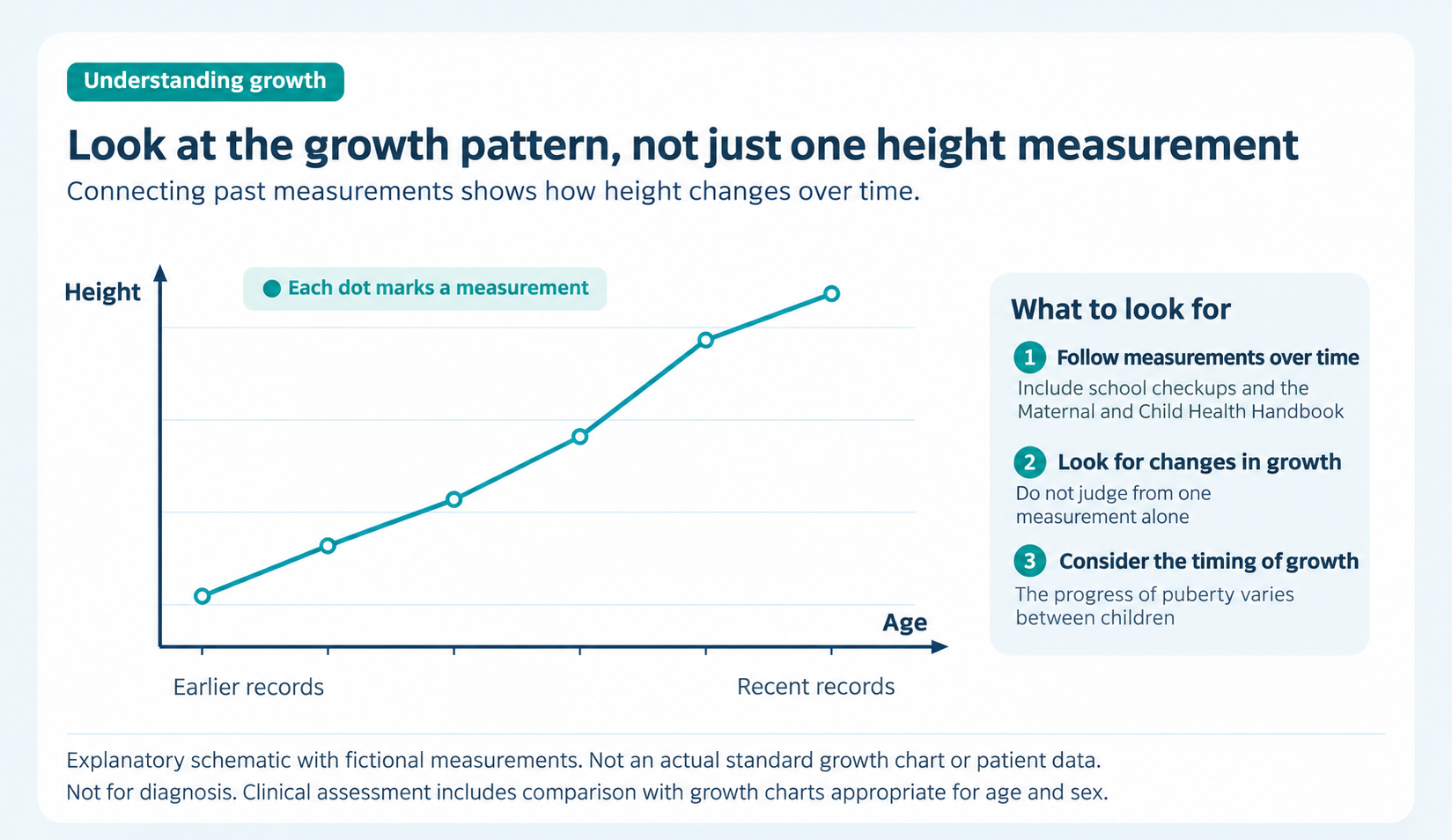
Plotting measurements from school health checkups or the Maternal and Child Health Handbook on a growth chart helps show your child’s own growth pattern. Alongside their current height, it is important to know when growth began to slow and how their weight has changed.
The timing of puberty varies from child to child. Growing earlier does not necessarily mean a child will be tall as an adult, and being small now does not mean there is no growth left. We look at past measurements together with physical development.
Connecting recorded height measurements shows how growth changes over time. The figure is an explanatory schematic using fictional measurements, not a diagnostic tool.
Reference: Japanese Society for Pediatric Endocrinology, “Short Stature”
https://jspe.umin.jp/public/teisinchou.html
2. Knee X-rays help assess whether the legs have room to grow
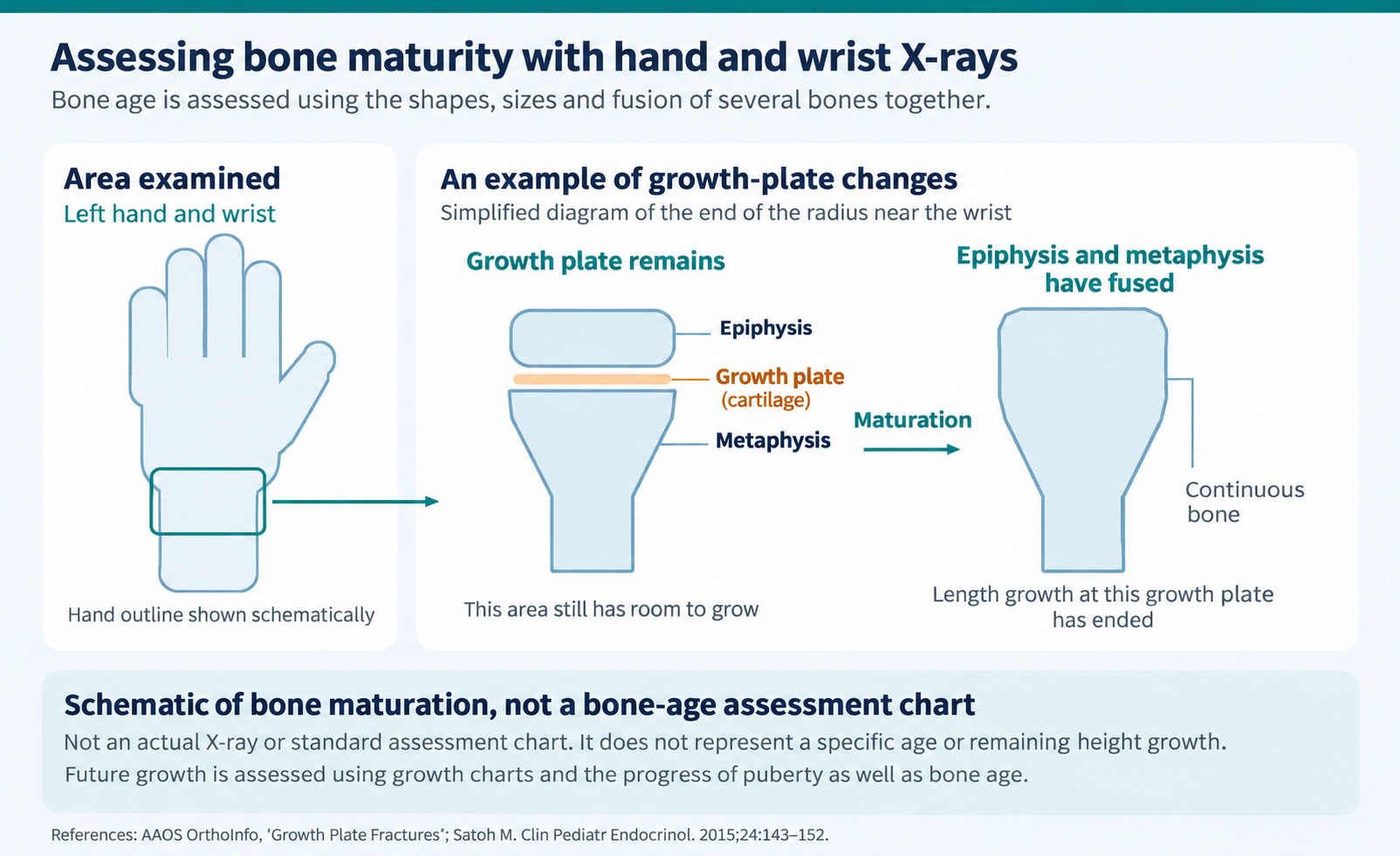
Children’s bones contain growth cartilage, also called growth plates, where bones grow in length. These areas can be identified on X-rays as growth-plate lines. There are also growth plates around the knee, in the femur and tibia.
At our clinic, when growth plates remain visible on a knee X-ray, we explain that there is still potential for the legs to grow. The condition of the growth plates is important when considering a child’s stage of growth.
However, an open-looking growth plate does not necessarily mean that a child will gain a large amount of height. The amount of growth and the time remaining vary between children. Height also depends on growth of the trunk, not just the legs.
A clear explanation that helps avoid misunderstanding is: “There is still growth cartilage around the knee, so the legs have room to grow. However, this image alone cannot tell us how many more centimeters you will grow.”
Reference: American Academy of Orthopaedic Surgeons, “Growth Plate Fractures”
https://www.orthoinfo.org/diseases–conditions/growth-plate-fractures/
3. What do pelvic X-rays and hand bone age tell us?
Growth indicators seen on pelvic X-rays
At our clinic, we use the maturity of the pelvic bones mainly as a guide when caring for patients with idiopathic scoliosis. The Risser sign is an indicator of the progression of ossification and fusion along the iliac crest, the upper edge of the pelvis.
When growth remains, attention is needed to the possibility of scoliosis progressing. However, decisions about treatment depend not only on bone maturity but also on the size of the spinal curve and how it changes. Remaining growth does not mean that scoliosis will always progress.
Pelvic findings also do not tell us final height or remaining growth in an exact number of centimeters.
Reference: Scoliosis Research Society, “Adolescent Idiopathic Scoliosis”
https://www.srs.org/Patients/Conditions/Scoliosis/Idiopathic-Scoliosis
Assessing “bone age” with hand X-rays
When growth needs a more detailed assessment, bone age can generally be evaluated from an X-ray of the left hand and wrist by examining the shapes of the bones and their degree of maturity. Separately from chronological age, this provides a guide to the stage of skeletal development.
Methods include comparing the image with standard images and assessing the maturity of individual bones. However, knowing bone age does not establish a child’s final height. Each prediction method has its own conditions and margin of error, and the outlook can change with factors such as the progress of puberty.
Not every child needs knee, pelvic, and hand X-rays. The necessary tests are chosen based on growth records and a clinical examination.
Hand and wrist X-rays assess the shapes and maturity of several bones together. The figure is a simplified schematic of changes in a growth plate. It is neither an actual X-ray nor a bone-age assessment chart.
Reference: Satoh M., “Bone age: assessment methods and clinical applications”
https://www.jstage.jst.go.jp/article/cpe/24/4/24_2015-0011/_article
4. Parents’ heights provide a rough guide to genetic background
Genetic factors also influence height. A guideline formula revised in 2007 for Japanese children uses heights in centimeters as follows:
Boys: (father’s height + mother’s height + 13) ÷ 2
Girls: (father’s height + mother’s height − 13) ÷ 2
The suggested range around this central value is ±9 cm for boys and ±8 cm for girls.
For example, for a boy whose father is 175 cm and mother is 160 cm tall, the central value is 174 cm. However, this calculation alone cannot predict that he will reach 174 cm or justify promising that he will grow to that height. The stated ranges also do not guarantee the prediction error for any individual child.
It is important to consider this guide based on parents’ heights together with the child’s own growth chart and skeletal maturity.
Reference: Ogata T, et al., “Target Height and Target Range for Japanese Children: Revisited”
https://www.jstage.jst.go.jp/article/cpe/16/4/16_4_85/_article
5. Does building stronger muscles through strength training stop height growth?
Parents of children who play soccer sometimes ask: “My child wants to strengthen their legs to kick the ball harder, but could that interfere with growth?”
Current evidence has not shown that strength training adapted to a child’s stage of development, and properly designed and supervised, adversely affects height growth or growth plates. The American Academy of Pediatrics also takes this position.
There is no evidence to support the explanation that stronger thigh muscles overpower the bones’ ability to grow and stop height growth. Muscle strength alone cannot tell us whether growth will be impaired.
However, this does not mean that every form of exercise is safe. Excessive loads, improper movements, and repeatedly exercising through pain can cause injuries. Injury to structures such as growth plates needs to be considered separately from gaining strength through appropriate training.
Looking only at the physiques of soccer players also does not allow us to conclude that the sport or strength training made them shorter.
Reference: American Academy of Pediatrics, “Resistance Training for Children and Adolescents” (2020; reaffirmed in 2024)
https://doi.org/10.1542/peds.2020-1011
6. Review nutrition and rest, not just the amount of exercise
During the growing years, learning correct movements comes before competing over how much weight a child can lift. With a coach or instructor, choose loads suited not only to age but also to physical development and experience.
When strength training, school sports, club practice, and independent practice are added together, there may be almost no time left to rest. Persistent fatigue after practice, continuing pain, or difficulty eating enough are reasons to review the training plan.
Children need food to support recovery and growth as well as energy for exercise. Rather than focusing only on protein, ensure sufficient overall food intake and a balanced diet, and make time for sleep and rest.
Correcting a nutritional deficiency is different from using supplements to make a healthy child grow taller. The Japanese Society for Pediatric Endocrinology states that there is no scientific evidence that giving supplements to children without nutritional deficiencies promotes growth.
References: American Academy of Pediatrics, “Resistance Training for Children and Adolescents”; Japanese Society for Pediatric Endocrinology, “Society Statement on Supplements and Other Products Advertised as Effective for Increasing Height”
https://doi.org/10.1542/peds.2020-1011
https://jspe.umin.jp/iframe/kenkai.html
7. When to seek advice and bring growth records
If you are concerned about your child’s height growth, bring records such as school health-check measurements when you seek advice. It is especially important to have an assessment if growth has clearly slowed compared with before, the child’s growth curve is moving downward away from its previous course, or puberty seems unusually early or late.
Being shorter than average does not necessarily mean a child has an illness. On the other hand, a change in growth pattern may warrant investigation even when height is within the average range. If a growth problem is suspected, evaluation by a pediatrician or pediatric endocrinologist may be needed.
If pain in the knee or elsewhere persists, we also check for sports-related problems separately from concerns about height. Rather than continuing to endure pain as something unavoidable during growth, seek advice early.
Reference: Pediatric Endocrine Society, “Child with Suspected Short Stature”
https://pedsendo.org/clinical-resource/child-with-suspected-short-stature/
Summary
Knee and pelvic X-rays can help us consider the potential for further growth. However, a single image cannot establish future growth or final height with certainty. We consider growth charts, the progress of puberty, parents’ heights, and, when needed, bone-age assessment together.
Properly supervised strength training has not been shown to stop height growth. During the growing years, it is particularly important to use appropriate loads that do not cause pain and to prioritize nutrition, sleep, and rest.
Frequently asked questions
Q. If the growth plates around the knee are open, will my child grow another 5 cm?
A. This helps us assess the potential for growth, but it cannot guarantee a specific amount such as 5 cm. We evaluate it together with the child’s growth pattern so far and skeletal maturity.
Q. If hand bone age is younger than chronological age, will my child definitely catch up?
A. This may indicate that skeletal maturation is progressing slowly, but it does not guarantee future growth. We also consider why growth is slow.
Q. Should my child avoid strength training until the growth plates have closed?
A. There is no basis for a blanket prohibition. Training appropriate to the child’s physical development, under suitable supervision, is important. If pain occurs, review the load; if it continues, seek medical attention.
Q. Does every child need X-rays to estimate their final height?
A. Not every child needs them. We first review growth records and physical development, then decide whether tests are necessary.
Related article
If your child also has knee pain, the following article includes a section on Osgood-Schlatter disease in growing children.
About the medical reviewers
Taketoshi Goda
Chairman, GOZEN Medical Corporation
Orthopedic specialist / Doctor of Medical Science
Takuro Sasaki
Director, Kita 7-jo Goda Orthopedics
Orthopedic specialist / Doctor of Medical Science / Occupational physician / Japan Sport Association-certified sports doctor
Naoki Seito
Director, Iwamizawa Goda Orthopedics
Orthopedic specialist / Doctor of Medical Science / Japanese Society for Replacement Arthroplasty-certified physician / Japan Sport Association-certified sports doctor
Article information
Intended audience: Growing children and their parents or guardians
Manuscript prepared: October 18, 2026
Original Japanese publication date: October 18, 2026
This article provides general information. Growth outlook and the tests needed vary depending on each person’s circumstances.
This article was translated from the original Japanese using AI. Not all staff at Kita 7-jo Goda Orthopedics are fluent in English, but we make every effort to communicate with you and help you feel understood.


