


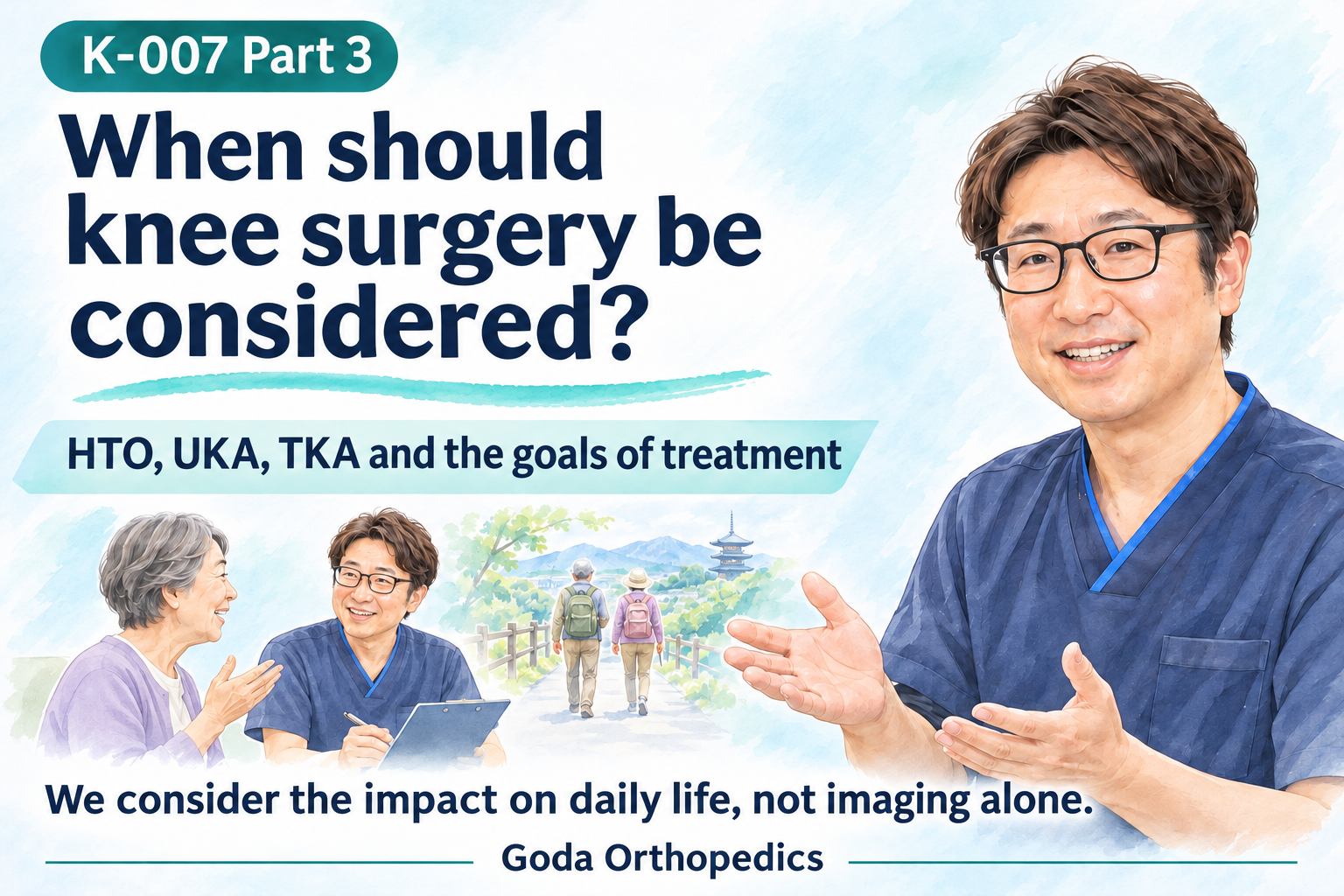
K-007 Knee Pain Treatment: How Do We Choose Between Medication, Injections, Rehabilitation, Regenerative Medicine and Surgery?
Part 3: When Is Surgery Needed? | HTO, UKA, TKA and the Goals of Treatment
Medical review
We may consider surgery for patients whose daily lives remain significantly restricted by knee pain despite continued conservative treatment.
However, a poor-looking X-ray does not automatically mean surgery.
26. “Advanced stage” and “end stage” do not mean the same thing
Some patients with severe knee deformity have become anxious after being told that their condition is already at its “end stage.”
At Goda Orthopedics, we avoid language that frightens patients unnecessarily and instead explain that the deformity has progressed.
Knee osteoarthritis (OA) is different from cancer. Advanced changes on imaging do not, by themselves, mean the condition is life-threatening.
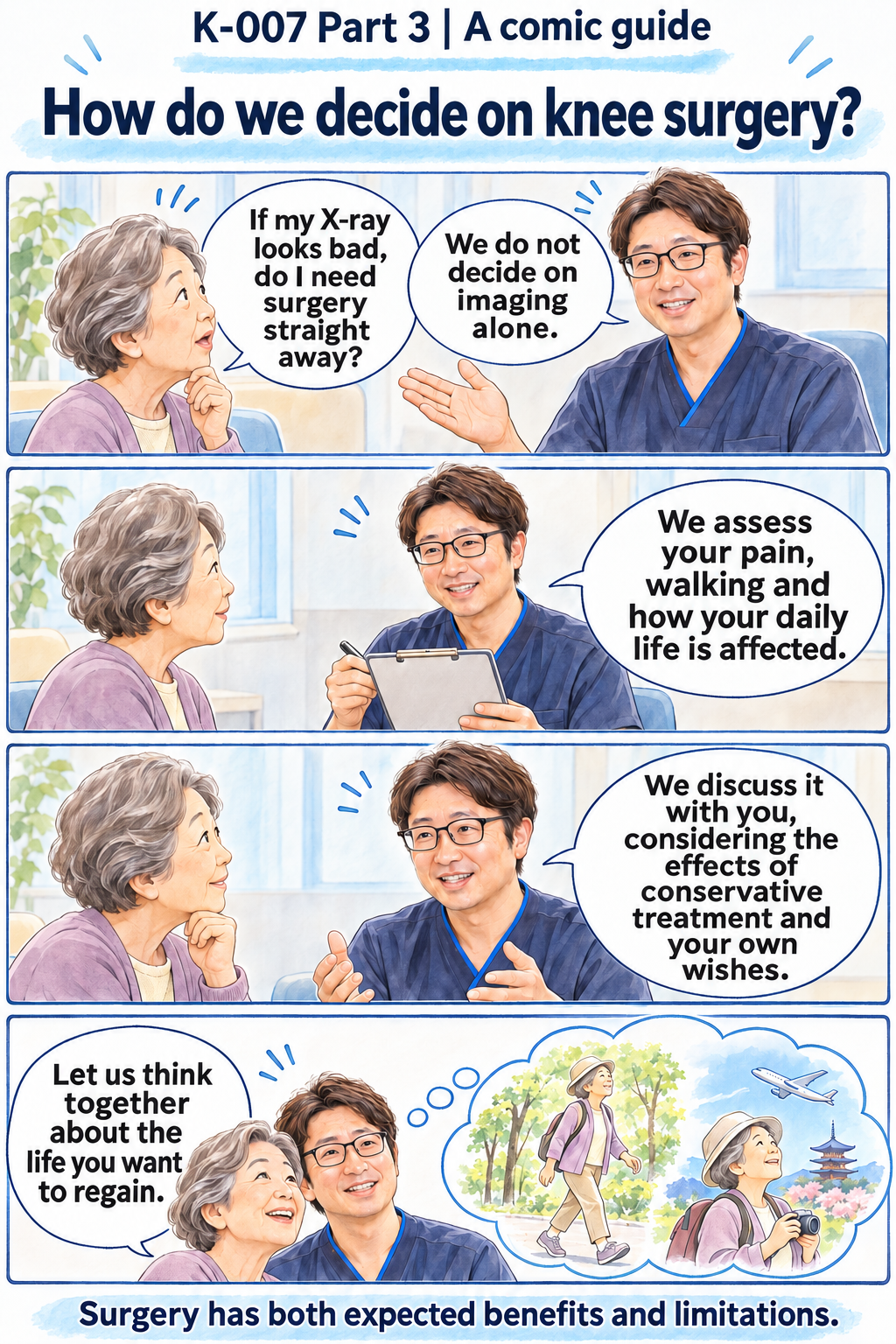
27. Daily life, rather than the X-ray, guides the decision about surgery
Some patients live with very severe deformity without much pain. Conversely, other patients are troubled by pain more severe than the degree of deformity on imaging might suggest.
We therefore do not decide whether to operate solely on the extent of changes on imaging. What matters most is how much knee pain interferes with that person's life.
Referral for or consideration of joint replacement is a clinical decision made when symptoms substantially impair quality of life (QOL) and appropriate nonsurgical treatment has not provided sufficient benefit.
28. Surgery is a treatment to help people regain an enjoyable life
The reason for knee surgery is not that the patient's life would be in danger without it.
Some patients have given up activities they want to enjoy, such as going for walks, playing golf, traveling, visiting hot springs or going to the zoo with their grandchildren, because of knee pain.
Helping them regain that life is a major aim of knee surgery.
29. We decide on the timing of surgery together with the patient
A doctor does not unilaterally decide, “Because of this X-ray, you will have surgery next month.”
One patient may feel, “With my life as it is now, I would still like to continue conservative treatment,” while another may say, “I can no longer walk, so I would like surgery.”
We make the decision while discussing what the patient wants to be able to do.
30. For older patients, we also need to think five years ahead
Older patients also require a somewhat different perspective. Even if medication and injections control pain now, there is no guarantee that the same treatment will allow them to manage daily life five years from now.
Depending on age and existing medical conditions, surgery itself may also become more difficult in the future.
In Hokkaido in particular, many older people live alone or as an older couple without other household members. We need to think together about how they would manage if their knee worsened further and they could no longer move around independently.
This explanation is not intended to create anxiety in order to promote surgery. It is intended to help patients consider their own future options.
31. HTO: Changing the weight-bearing axis while preserving your own joint
High tibial osteotomy (HTO) is surgery that cuts the tibia to change alignment and shift the load concentrated on the inner side of the knee toward the outer side.
A major feature is that it preserves the patient's own knee joint. It may be selected for relatively active patients, among others.
If deformity progresses in the future, knee replacement may also be considered.
32. UKA: Replacing only the damaged part with an artificial joint
UKA (unicompartmental knee arthroplasty) is a procedure that replaces one part of the knee with an artificial joint.
When the indications are appropriate, it can preserve the healthy portions of the knee and the ligaments, and makes it easier to achieve movement closer to the knee's natural motion.
However, it is not suitable for every patient.
33. TKA: Replacing the whole knee joint with an artificial joint
TKA (total knee arthroplasty) is used in situations such as widespread progression of deformity.
There have been advances in implants, surgical techniques, perioperative care and rehabilitation.
However, it is not a simple matter of saying that HTO, UKA or TKA is the best. We select the procedure by considering age, the location of deformity, ligament function, activity level, bone condition and other factors together.
34. The surgeon's experience also influences the choice of procedure
There may be more than one possible operation for the same knee.
In that situation, the decision takes into account the patient's condition, the features of each procedure, the implant to be used and the surgeon's experience.
What matters is making the choice after explaining the advantages and disadvantages of each option to the patient.
35. The goal of joint replacement is to walk without pain getting significantly in the way
At Goda Orthopedics, the goal we consider most important in knee replacement surgery is enabling patients to walk without pain substantially interfering.
We do not make the ability to sit in seiza, the traditional Japanese kneeling position, the main goal. The ability to bend the knee deeply varies from person to person, and many patients still find seiza difficult after joint replacement.
36. We do not say that surgery will eliminate all pain
Even after joint replacement surgery, not every sensation returns to how it was before.
Some patients may continue to experience wound pain, discomfort in cold weather, numbness or reduced sensation around the knee, or an awareness of the artificial implant.
We therefore do not tell patients that surgery will reduce their pain to zero with 100% certainty.
37. Surgical success means helping patients regain their lives
Even if the postoperative X-ray looks good, patients may not be sufficiently satisfied if they feel they cannot live the life they expected.
On the other hand, being able to say, “I could not go out before, but now I can travel,” is a meaningful improvement.
Surgical success therefore needs to be assessed not only by imaging, but also by how much of their life patients themselves have regained.
K-007 summary: The aim of knee treatment is more than simply treating the knee
We consider knee pain treatment in stages: diagnosis → pain control → medication and injections → rehabilitation → improvement in weight and alignment → regenerative medicine if needed → surgery if needed.
The ultimate aim is neither to make an X-ray look good nor simply to reduce pain to zero.
It is to help patients regain a life in which they can walk, work, travel, enjoy hobbies and go out with their families.
Frequently asked questions about knee pain treatment
Q1. Can knee osteoarthritis be cured with medication alone?
Medication is one way to reduce pain and inflammation. We combine treatments that also address muscle strength, range of motion, weight, alignment and other factors.
Q2. How many hyaluronic acid injections are needed before they work?
This depends on the preparation and the patient's condition. At Goda Orthopedics, we monitor changes in symptoms as we use them, and consider other treatments if the response is limited.
Q3. Should I exercise even if my knee hurts?
There is no need to endure pain to perform high-load exercise. We tailor exercise to the condition, using options such as isometric exercises or walking within a pain-free range.
Q4. Will losing weight improve knee pain?
For knee osteoarthritis accompanied by overweight or obesity, weight loss may improve pain and function.
Q5. Does PRP-FD regenerate cartilage?
It cannot be described as a treatment that regenerates cartilage back to its original condition. We position it as one option aimed at improving pain and function.
Q6. Can regenerative medicine also heal meniscal and ligament tears?
We do not expect a torn meniscus or ruptured ligament to be completely restored to its original condition by injections alone. Treatment appropriate to the underlying condition is needed.
Q7. Is surgery necessary if the deformity on X-ray is severe?
We do not decide on imaging alone. We consider the response to conservative treatment, walking ability, interference with daily life and the life the patient wants to lead.
Q8. Will joint replacement completely eliminate the pain?
Improvement in pain and function can be expected in many patients, but wound pain, discomfort or other symptoms may remain. It is important to explain the expected benefits and limitations before surgery.
Completed related articles
- K-001: Where Does Your Knee Hurt? | Possible Causes Based on the Location of Pain — Part 1
- K-002: When Does Your Knee Hurt? | Possible Causes Based on Painful Movements — Part 1: Walking, Stairs and Standing Up
- K-003: Symptoms That Accompany Knee Pain | Swelling, Fluid, Warmth, Catching and Giving Way
- K-004: Should I See a Doctor for This Knee Pain? | Pain You Can Monitor and Pain That Needs Prompt Assessment — Part 2: When to Monitor or See a Doctor
- K-005: How Do Orthopedic Doctors Diagnose Knee Pain? | Medical History, Inspection, Palpation and Hands-on Tests — Part 1 / Part 2
- K-006: Tests for Knee Pain | What Can X-rays, MRI and Ultrasound Show? — Part 1 / Part 2
About the medical review
This article is based on Dr. Goda's actual knee treatment practices and clinical experience in general orthopedic care as its primary source. It does not present a specialist opinion from a knee subspecialist.
The medical review checked the following against standard medical knowledge: exercise therapy and weight management when needed are central to knee OA treatment; topical NSAIDs are a medication option for knee OA; PRP may improve pain and function, but the certainty of the evidence is limited; the effectiveness and long-term safety of mesenchymal cell culture supernatant as a standard treatment have not been established; and decisions about joint replacement emphasize symptoms, function, quality of life and response to conservative treatment, not imaging alone.
Medical reviewer profiles
Chairman, GOZEN Medical Corporation / Orthopedic specialist / Doctor of Medical Science
Director, Kita 7-jo Goda Orthopedics / Occupational physician / Japan Sport Association-certified sports doctor
Director, Iwamizawa Goda Orthopedics / Orthopedic specialist / Doctor of Medical Science / Japanese Society for Replacement Arthroplasty-certified physician / Japan Sport Association-certified sports doctor
Article information
Article number: K-007
Article title: Knee Pain Treatment: How Do We Choose Between Medication, Injections, Rehabilitation, Regenerative Medicine and Surgery?
Part: Part 3 / Surgery, HTO, UKA, TKA, Joint Replacement and the Goals of Treatment
Series: Goda Orthopedics' Guide to Knee Pain
Medical review: Taketoshi Goda / Takuro Sasaki / Naoki Seito
Published: November 3, 2026 (Tuesday)
Updated: November 9, 2026 (Monday)
This article was translated from the original Japanese using AI. Not all staff at Kita 7-jo Goda Orthopedics are fluent in English, but we make every effort to communicate with you and help you feel understood.


