


K-007 Knee Pain Treatment: How Do We Choose Between Medication, Injections, Rehabilitation, Regenerative Medicine and Surgery?
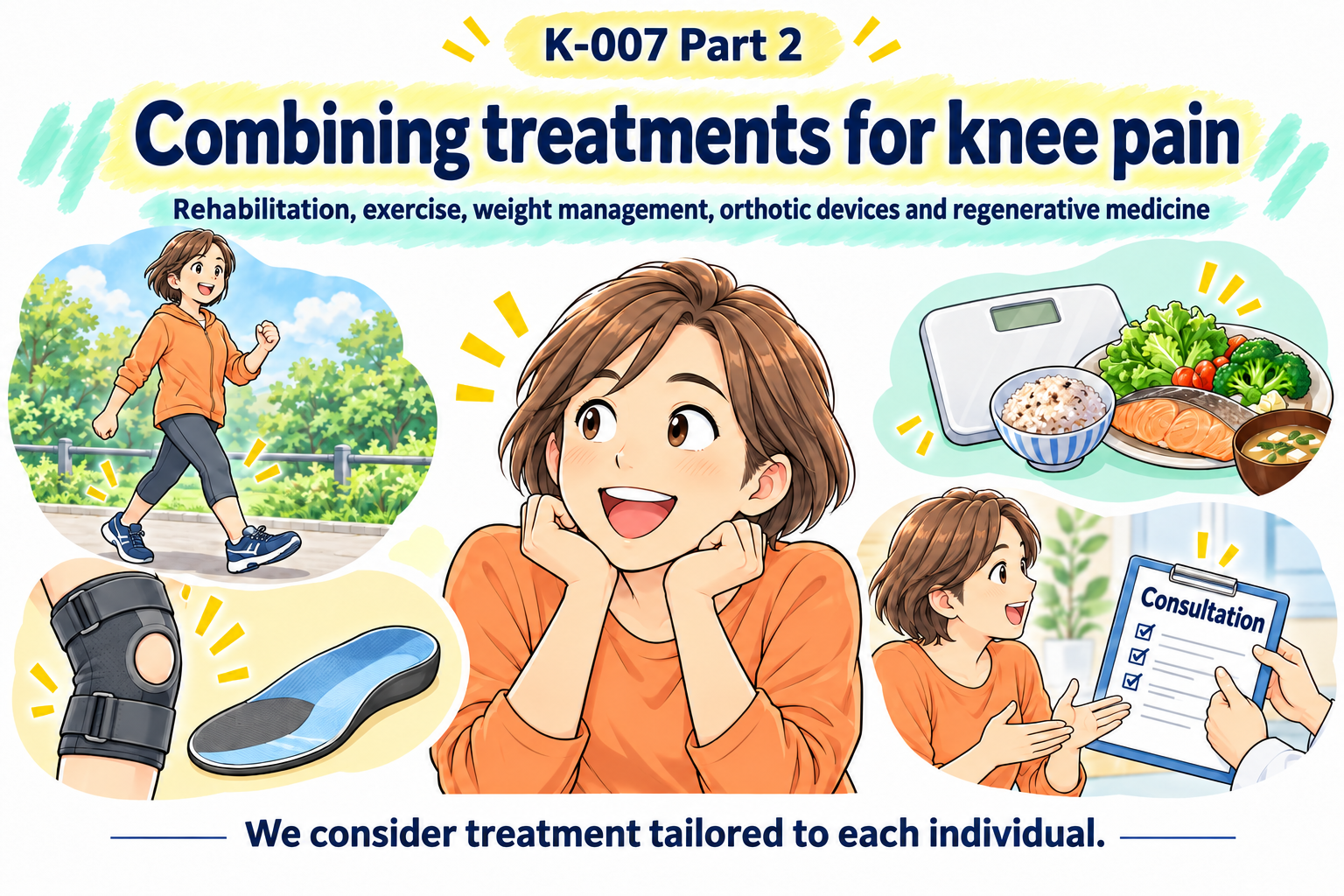
Part 2: Rehabilitation, Exercise, Weight Management, Orthotic Devices and Regenerative Medicine
Medical review
Treatment for knee pain does not end simply because an injection has reduced the pain.
In knee osteoarthritis, muscle strength, range of motion, body weight, alignment and the loads placed on the knee in daily life also affect symptoms.
For this reason, Goda Orthopedics provides rehabilitation alongside medication and injections.
10. Rehabilitation places particular emphasis on the quadriceps
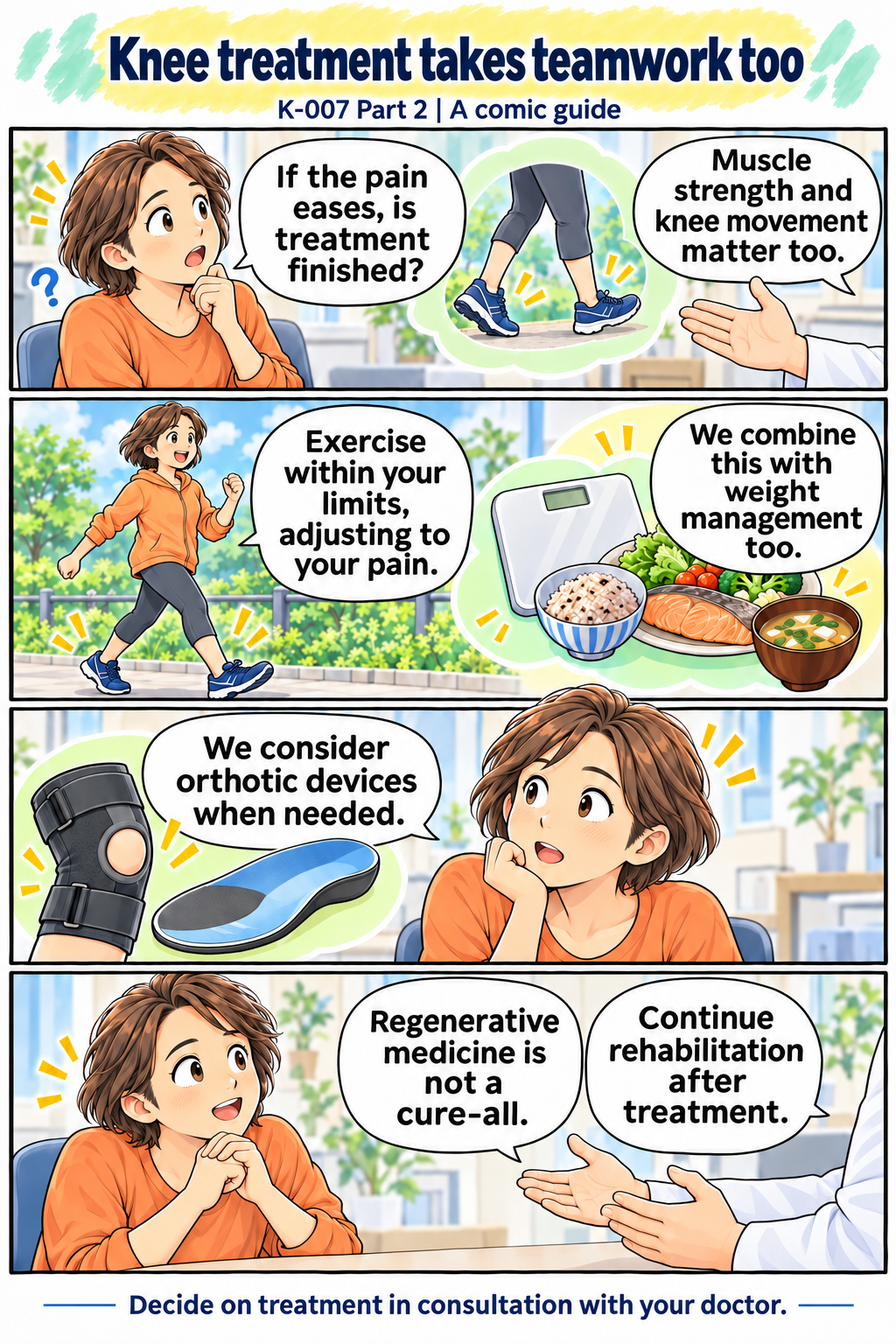
The quadriceps are particularly important muscles in rehabilitation for knee pain. They straighten the knee and play an important role in supporting the body during walking.
For knee osteoarthritis, exercise therapy, including strength training focused on the quadriceps and aerobic exercise, is a foundation of treatment.
11. We also work on range of motion
It is not only muscle strength that matters, but also how far the knee can straighten and bend. If the knee remains bent and can no longer straighten, walking is affected as well.
We therefore combine strength training with knee extension exercises and exercises to improve the range of flexion. If the hip also has a contracture, we plan rehabilitation that addresses hip range of motion and muscle strength as well.
12. Some strength exercises are possible even when pain is severe
There is no need to force a painful knee into a deep bend.
When pain is severe, methods such as isometric exercises allow the muscles to contract without moving the knee very much. If needed, electrical stimulation such as EMS may also be used to support strength training.
The important point is to avoid both doing nothing because it hurts and forcing the knee to bend despite the pain.
13. Continue walking within your limits
Having knee pain does not mean all walking is prohibited.
Walking within a range that does not significantly worsen pain can help maintain overall fitness and muscle strength.
14. Cycling is not prohibited for everyone either
Cycling allows the knee to move while the saddle supports body weight, making it an accessible form of exercise for some patients.
The angle of knee flexion changes depending on factors such as saddle height. If the setup does not provoke pain, cycling does not necessarily need to be prohibited.
15. We do not recommend deep squats
Squatting with the knees deeply bent increases the load on the patellofemoral and tibiofemoral joints.
We therefore do not tell patients with knee pain to simply squat as deeply as possible to build strength. We adjust the depth and load to suit the patient's condition, muscle strength and pain.
16. Weight management is also part of knee treatment
Weight management is important for patients with knee osteoarthritis who are overweight or have obesity.
During walking, forces greater than body weight repeatedly act on the knee. Reducing body weight can therefore reduce the load on the knee.
In osteoarthritis (OA) accompanied by overweight or obesity, weight loss is known to improve pain and physical function.
17. Simply saying “Please lose weight” is not treatment
Telling a patient who cannot walk because of knee pain to exercise and lose weight may be difficult to put into practice.
It is therefore important to relieve pain first and, when needed, combine this with medical weight management to establish a sequence of losing weight → reducing knee pain → becoming able to move → maintaining muscle strength.
For knee OA accompanied by obesity, reports also suggest that medication-based weight management may improve knee pain and physical function. However, the indications, side effects, nutrition and muscle mass need to be considered. The same treatment is not given to everyone.
18. Insoles and knee supports may also be used
For patients with uneven weight distribution due to varus deformity or other factors, we may consider insoles or orthotic devices. The aim is to adjust the direction of the forces acting on the knee.
However, these are not used uniformly for all patients. We consider them individually, for example when joint instability or abnormal loading is present and exercise therapy alone is insufficient.
Knee supports may be used to assist stability, but it is important not to rely solely on wearing them regularly and to continue strength training at the same time.
19. Insoles and HTO are not the same treatment
Insoles and high tibial osteotomy (HTO) share the general aim of shifting a load concentrated on the inner side of the knee toward the outer side.
However, their treatment effects and corrective capacity are not the same. HTO is surgery that cuts the bone to actually change lower-limb alignment, whereas insoles are a form of conservative treatment.
20. Regenerative medicine may be considered an option between conservative treatment and surgery
Goda Orthopedics offers PRP-FD (a freeze-dried preparation) and mesenchymal cell culture supernatant as self-pay treatment options outside insurance coverage.
However, the most important point about regenerative medicine is not to describe it as a treatment that regenerates cartilage back to its original condition.
21. What role does PRP-FD have?
PRP-based treatments use platelet-derived components with the aim of improving pain and inflammation.
Although PRP for knee OA may improve pain and function, outcomes vary depending on the preparation and patient selection, and the certainty of the evidence is limited.
At Goda Orthopedics, we consider it an intermediate option for patients who have not obtained sufficient benefit from hyaluronic acid or rehabilitation alone but do not wish to proceed immediately to surgery.
22. Regenerative medicine alone may not resolve advanced knee problems
When deformity is severe, the joint space is markedly narrowed, alignment abnormalities are substantial, or daily life is significantly impaired, it may be difficult to obtain sufficient benefit from injections alone.
In the doctor's clinical experience as well, patients with relatively mild deformity tend to be more likely to notice benefits from PRP-FD.
23. About mesenchymal cell culture supernatant
Goda Orthopedics also offers mesenchymal cell culture supernatant as a self-pay treatment option.
However, this cannot be described as a standard treatment for knee OA with established effectiveness and long-term safety. Although research is progressing, clinical evidence remains limited.
It is therefore necessary to explain the limitations of the current evidence alongside the potential benefits.
24. We do not expect injections to restore a meniscus or ligament to its original condition
Using PRP or culture supernatant does not allow us to say that a torn meniscus will return to its original condition, a ruptured cruciate ligament will be completely repaired, or lost cartilage will definitely regenerate.
Regenerative medicine is not an all-purpose repair treatment. We position it as a treatment aimed at improving symptoms, in combination with other treatments.
25. Continue rehabilitation rather than stopping at regenerative medicine
Undergoing regenerative treatment does not mean there is nothing more to do.
If muscle weakness, restricted range of motion, weight-related issues or alignment problems are present, those problems remain.
We therefore plan treatment as a combination of regenerative medicine, rehabilitation and weight management.
Part 2 summary: Knee treatment is not completed with a single approach
For some patients, injections alone, medication alone, strength training alone or weight loss alone are not sufficient to improve knee pain.
It is important to improve muscle strength, range of motion, weight, alignment and the loads placed on the knee in daily life together, while controlling pain.
Continued in Part 3
K-007 Part 3: When Is Surgery Needed? | HTO, UKA, TKA and the Goals of Treatment
Part 3 explains when to move from conservative treatment to surgery, the differences between HTO, UKA and TKA, why surgery is not decided on imaging alone, planning for the future in older patients, and the goals and limitations of joint replacement surgery.
About the medical review
This article is based on Dr. Goda's actual practices and clinical experience with exercise therapy, weight management, orthotic devices and regenerative medicine in general orthopedic care as its primary source. The medical descriptions of exercise therapy, weight loss, PRP, culture supernatant and other topics have been checked against standard guidelines and medical literature, and edited for patients to include the limitations of the current evidence.
Medical reviewer profiles
Chairman, GOZEN Medical Corporation / Orthopedic specialist / Doctor of Medical Science
Director, Kita 7-jo Goda Orthopedics / Occupational physician / Japan Sport Association-certified sports doctor
Director, Iwamizawa Goda Orthopedics / Orthopedic specialist / Doctor of Medical Science / Japanese Society for Replacement Arthroplasty-certified physician / Japan Sport Association-certified sports doctor
Article information
Article number: K-007
Article title: Knee Pain Treatment: How Do We Choose Between Medication, Injections, Rehabilitation, Regenerative Medicine and Surgery?
Part: Part 2 / Rehabilitation, Exercise, Weight Management, Orthotic Devices and Regenerative Medicine
Series: Goda Orthopedics' Guide to Knee Pain
Medical review: Taketoshi Goda / Takuro Sasaki / Naoki Seito
Published: To be determined
Updated: To be determined
This article was translated from the original Japanese using AI. Not all staff at Kita 7-jo Goda Orthopedics are fluent in English, but we make every effort to communicate with you and help you feel understood.


